




The search for an HIV vaccine has become an exercise in precision engineering. Rather than simply exposing the immune system to HIV proteins and hoping it produces protective antibodies, researchers are designing vaccines to find rare precursor B cells and guide them through the complex process that can eventually produce broadly neutralising antibodies.
Now, two studies from researchers at Scripps Research, the University of Texas Medical Branch and IAVI suggest that another feature of vaccine design could be important: how strongly a vaccine nanoparticle engages its target B cells.
The first study explored how avidity affects the durability of the immune response, while the second investigated how it influences which immune cells are most successful during that response.
Whilst their findings are preclinical, they offer researchers another variable to optimise as they attempt to guide the immune system towards making broadly neutralising antibodies capable of blocking multiple HIV strains.
Avidity or Affinity?
Affinity describes the strength of a single interaction between a binding site and its target.
Avidity describes the combined strength of multiple interactions.
A nanoparticle carrying repeated copies of an antigen can therefore achieve high avidity by engaging several binding sites on a B cell at once. The new studies suggest that this overall ‘grip’ can influence which B cells gain an advantage during vaccination.
What did the researchers change?
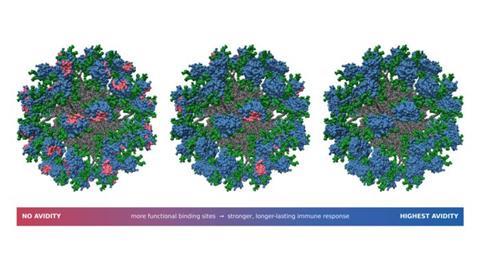
The Scripps Research team created six types of vaccine nanoparticles with different levels of repetitiveness. The most repetitive nanoparticles carried 60 functional attachment points while the least had none.
The researchers then vaccinated mice whose precursor B cells had been adapted to recognise the specific attachment point on the nanoparticles.
In the first study, greater repetitiveness produced a longer-lasting immune response, including increased production and persistence of memory B cells, long-lived plasma cells and antibodies in the bloodstream.
The researchers also tested the effect of changing the strength of individual attachment points. This influenced several immune responses too, but repetitiveness generally had the stronger effect.
The second study looked inside germinal centres, specialised areas where activated B cells compete, proliferate and mature.
There, B cells that recognised highly repetitive nanoparticles were preferentially able to mature compared with B cells exposed to less repetitive nanoparticles. Stronger individual binding also improved B-cell success, but not as much as increased repetitiveness.
“So basically, higher overall binding strength allowed the B cells targeting that attachment point to compete better against other B cells, which is really exciting,” said Christopher Cottrell, an author on both studies.
Why does this matter for early drug discovery?
Although this is vaccine research rather than conventional small-molecule drug discovery, the work illustrates an increasingly important principle in biomedical research: what a therapeutic molecule does can depend not only on what it binds to, but how that interaction is presented.
The researchers deliberately altered the number and strength of attachment points on vaccine nanoparticles while keeping other characteristics, including particle size, constant. This allowed them to investigate how different aspects of binding affected the immune response.
For vaccine developers, that makes nanoparticle architecture another potential design parameter alongside the antigen itself, dose, formulation and delivery system.
It could be especially important for HIV because the B cells capable of developing into broadly neutralising antibody-producing cells can be rare. A successful vaccine may therefore need to do more than activate these cells. It may need to help them compete successfully against other B cells.
How does this fit with what is already happening in the field?
The work builds on a broader strategy known as germline targeting, which aims to activate rare precursor B cells capable of developing into broadly neutralising antibody-producing cells.
That approach has become a major focus of HIV vaccine research because conventional vaccination has struggled to generate bnAbs reliably.
Previous work from William Schief and colleagues demonstrated that a nanoparticle-based vaccination strategy could produce mature, functional broadly neutralising antibodies capable of blocking multiple HIV strains in non-human primates. The researchers thought that the nanoparticle used during the final vaccination was an important part of that success.
The new studies investigate why that might be the case.
“We’re trying to dial all the knobs we can in terms of vaccine design to get the strongest possible immune responses to stop HIV,” said Schief, a co-senior author of both studies. “Both of these papers show that nanoparticles with higher overall binding strength lead to stronger immune responses at basically every stage of the overall response. This makes overall binding strength a promising aspect to explore to make better vaccines.”
The latest findings therefore represent less of a new direction than an additional layer of precision in an already highly engineered field.
Key takeaways
- More repetitive nanoparticles produced more durable responses. Mice developed greater numbers of memory B cells, long-lived plasma cells and circulating antibodies.
- Structure mattered, not just quantity. The researchers found that the repetitive arrangement of binding sites was important rather than simply increasing the total number of stimulating sites.
- B-cell competition is central. Highly repetitive nanoparticles gave the desired precursor B cells an advantage within germinal centres, where B cells compete and mature.
- The findings could help explain a translational challenge. Vaccine designs that perform well in simplified animal models may behave differently when confronted with the much more diverse B-cell populations found in humans.
What does it mean for researchers?
Perhaps the most important finding for researchers is that competition between B cells changes the outcome.
When the researchers reduced the population of competing precursor B cells in their mouse model, the advantage created by greater nanoparticle repetitiveness disappeared.
That could help explain why some vaccine designs have performed well in early preclinical studies but subsequently struggled in humans. Simplified animal models may contain less competition between B-cell populations than occurs in people.
For researchers, the implication is that vaccine candidates may need to be assessed in models that better reflect the diversity and competition of the human immune system.
It also reinforces the idea that nanoparticle design can be used to actively shape the immune response rather than simply deliver an antigen.
What happens next?
The key question is whether the findings translate beyond these engineered mouse models.
Further studies will need to establish whether increasing avidity produces similarly durable B-cell and antibody responses in more representative animal models and ultimately in humans.
The research does not bring an HIV vaccine immediately closer to the clinic but it does provide another engineering ‘dial’ for researchers to adjust as they work towards the much harder goal of generating broadly neutralising antibodies that persist.
Disclaimer: This content has not been generated, created or edited by Finance SC. Publisher:
Source link
Source link