




At first glance, it looked like a star. Then astronomers measured its light and found something no star should be able to do.
In striking new images from the James Webb Space Telescope (JWST), the object appears as little more than a brilliant red point. Its light carries a signature commonly associated with stellar atmospheres. Yet the source is far too luminous to be an ordinary star. Instead, astronomers argue that they may be seeing a black hole wrapped inside such a dense envelope of hydrogen that the whole structure radiates almost like an enormous star.
They call it a “black hole star,” an entirely new type of cosmic object.
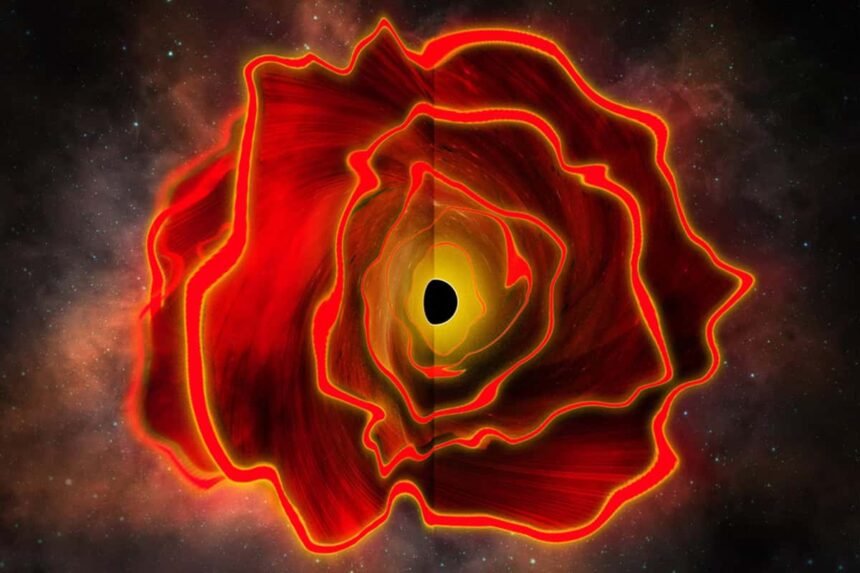
The object in question, named MoM-BH-1*, existed just 660 million years after the Big Bang. In a new study published in Nature, researchers propose that a young black hole sits inside a turbulent, nearly dust-free cocoon of gas extending tens of astronomical units — roughly the scale of the Solar System.
If that interpretation holds up, the discovery could do more than add another exotic object to astronomy’s catalogue. It may help explain the strange “little red dots” that JWST has found in large numbers across the early universe — and perhaps show astronomers how some of the first supermassive black holes grew so quickly.
“What exactly these objects are has been one of the most debated topics of the JWST era,” lead author Rohan Naidu said in MIT News.
The Clue Hidden in a Sudden Drop in Light

Naidu and his colleagues embarked on the “Mirage or Miracle” survey, which was initially designed to investigate exceptionally bright objects appearing remarkably early in cosmic history.
MoM-BH*-1 immediately stood out. It was the reddest source in the roughly 250-square-arcminute field examined by the researchers and effectively vanished in JWST’s shorter-wavelength images. Light from very far away (or billions of years ago) gets red-shifted, meaning its wavelength is stretched, by the acceleration of the expansion of the universe.
Spectroscopy revealed that the object’s brightness plunges by more than a factor of 20 when measured at certain wavelengths. Astronomers call this underlying feature a Balmer break. Hydrogen atoms can absorb light particularly efficiently across this part of a spectrum when enough electrons occupy a particular energy state. Ordinary stellar populations can produce Balmer breaks because their atmospheres contain such hydrogen.
But this one was extreme.

The researchers measured a break strength of about 7.7. A typical dust-free population of stars should top out around 3; even an artificial population composed entirely of A-type stars, which produce especially strong breaks, should remain below about 5.
“The break we observed in this object is the deepest break we have ever observed in any object, ruling out ‘ordinary’ stars as the source,” Naidu said.
At the same time, MoM-BH*-1 shows enormously broad hydrogen emission and deep absorption in the H-beta and H-gamma lines. The combination points toward exceptionally dense gas. Crucially, very little dust is required.
That overturns the obvious explanation for why the object looks so red. Astronomers often assume distant red objects have been reddened by dust, much as smoke makes sunlight appear redder near the horizon. Here, instead, dense hydrogen itself absorbs and reprocesses the shorter-wavelength radiation.
“The spectrum we detected is our best evidence of a cloak of gas feeding an early-forming black hole,” Naidu said.
A Black Hole Pretending To Be a Star
The nickname “black hole star” is deliberately paradoxical. The object is not a star in the conventional sense.
A normal star contains a dense ball of plasma whose central nuclear fusion supplies energy. In the researchers’ model, the engine is instead an accreting black hole. Its radiation passes through an immense envelope of hydrogen, which acts rather like a pseudo-atmosphere.
The black hole’s mass remains unusually uncertain. Standard techniques infer black hole masses from the widths and brightness of emission lines. But those techniques assume the line width largely reflects fast-moving gas orbiting the black hole.
Here, photons may instead scatter repeatedly through the surrounding hydrogen and emerge with artificially broadened spectral lines. If so, conventional calculations could overestimate the black hole’s mass by as much as two orders of magnitude. The team’s preferred physical models put it around the million-solar-mass scale, although other assumptions produce much higher values.
Although it might sound wild, the idea of “black hole stars” has gathered support elsewhere. A 2024 study that helped establish little red dots as a distinct JWST population interpreted their broad hydrogen lines as evidence for rapidly accreting black holes. More recently, a 2026 Nature study of high-quality JWST spectra found that electron scattering through dense gas could make those lines appear much broader, reducing inferred black hole masses by roughly a factor of 100.
Why the Little Red Dots Matter

Most little red dots appear to contain both a black-hole-powered source and stars belonging to a surrounding galaxy. Their light overlaps, making it difficult to determine which component produces which spectral feature.
MoM-BH*-1 is different. The black hole component appears to overwhelm almost everything around it.
“Every little red dot is consistent with being a black hole star, embedded in a generic early galaxy,” Naidu said. “But what is special about MoM-BH*-1 is, the black hole star is essentially completely outshining its surrounding host galaxy.”
There is, however, a more substantial galaxy nearby, about 60 kiloparsecs away in projection. The researchers estimate that the two systems could merge in about 100 million years. Intriguingly, when they mathematically combine the spectrum of MoM-BH*-1 with that neighboring galaxy, the result looks strikingly like a typical little red dot.
This development offers a tidy evolutionary pathway for little red dots: a young black hole grows while buried inside an extraordinarily thick supply of gas, later becoming embedded within a more recognizable galaxy.
Such an environment could also help solve one of astronomy’s longstanding problems. Astronomers have found black holes approaching a billion solar masses less than 700 million years after the Big Bang. Scientists’ models for how black holes grow struggle to explain the timing of such gargantuan monsters. But dense envelopes can trap radiation that would otherwise push infalling matter away, potentially allowing black holes to feed above the usual Eddington limit.
Still, the researchers repeatedly caution that their model is deliberately simplified. The geometry of the gas remains uncertain, and even the apparent 30 percent brightening seen over 56 days in the object’s own rest frame — tantalizing evidence of an active black hole — comes from different observing modes and needs confirmation.
For now, astronomers have not conclusively proved that JWST has found an entirely new species of cosmic object. But they may finally be getting a view beneath the red disguise that has made the early universe so puzzling.
The little red dots may not be inexplicably ancient galaxies or familiar quasars hidden behind dust, as some have proposed before. Some could instead be black holes caught in an extraordinarily brief stage of youth — still buried inside the gas that is helping them become the giants that might one day power an entire galaxy.
Disclaimer: This content has not been generated, created or edited by Finance SC. Publisher:
Source link
Source link