


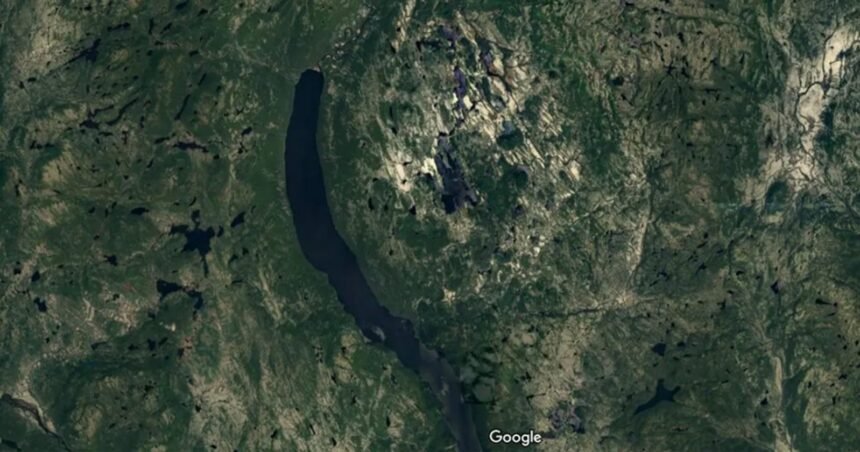
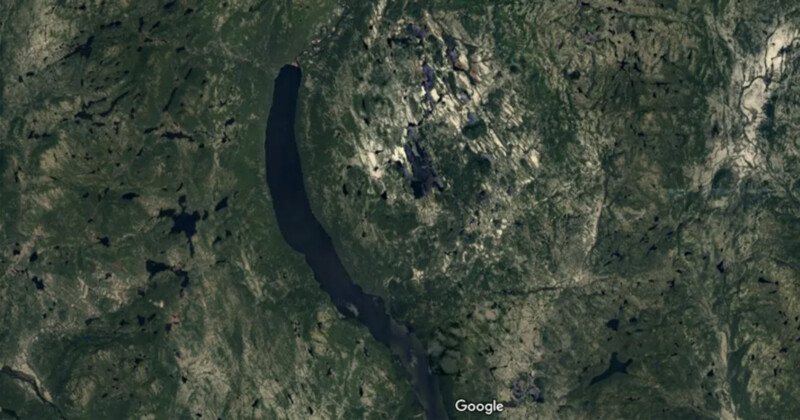
When Joël Lapointe was planning an epic camping trip through the Côte-Nord region of Quebec on Google Maps, an area gave him pause for thought: it looked like a giant meteor crater.
“I get lots of messages from the public thinking they have found a crater and 99/100 turn out not to be the case,” Gordon Osinski, a planetary geology professor at Western University, tells Live Science. “This is one of those rare examples that shows this is possible.”
After Lapointe contacted professional researchers when he discovered the suspicious pit in 2024, a team of geologists set out to investigate the remote area.
“This was one of the most arduous expeditions I’ve ever done — and I’ve done 25 expeditions to the Arctic and six continents,” Osinski tells Live Science. “The terrain was incredibly rough and rugged, plus lots of bugs.”
The terrain was so rugged and overgrown that the seaplane had to drop them over 150 feet offshore, forcing them to wade through the water with all their gear.
To confirm that the site was created by a meteor, Osinski and his team searched for shatter cones, which are traces of shock waves left behind in the rock that are unique to meteor impacts and nuclear bomb test sites. They observed shatter cones on the second day there.
Adding to the evidence, the team also found “spectacular examples” of impact melt rock. “You can melt literally tens of cubic kilometres of the Earth’s crust when you get a big enough asteroid hitting,” Osinski tells CBC.
The team has now dated the previously unidentified crater as a 390-million-year-old meteor impact. There are only 200 known meteor craters in the entire world, and the one in Quebec is 15 miles wide, making it one of the bigger discoveries in recent years.
Lapointe, who is also an amateur astronomer, says he’s pleased about the news.
“It’s not every day that an ordinary citizen finds a 390-million-year-old crater,” he says. “I encourage everyone to not ignore intuition or an observation, even if it isn’t part of your field of expertise.”
There are a confirmed 31 meteor craters in Canada, with an estimated 50 in the United States.
PetaPixel articles may include affiliate links; if you buy something through such a link, PetaPixel may earn a commission.
Love PetaPixel? Go Premium.
PetaPixel is the world’s largest independent photography publication and we’re only able to continue our work with your help. Become a PetaPixel Member now and support our mission to bring you regular, high-quality reviews, features, news, and more.
- Remove banner ads
- Gain access to full-resolution RAW and JPEG Sample Galleries
- Get 5% off orders from KEH.com
- Get a $15 coupon to spend at Moment
- Get 10% off lighting equipment from FJ Westcott
- Get 10% off film development, scanning, and printing from Blue Moon Camera and Machine
Disclaimer: This content has not been generated, created or edited by Finance SC. Publisher:
Source link
Source link