



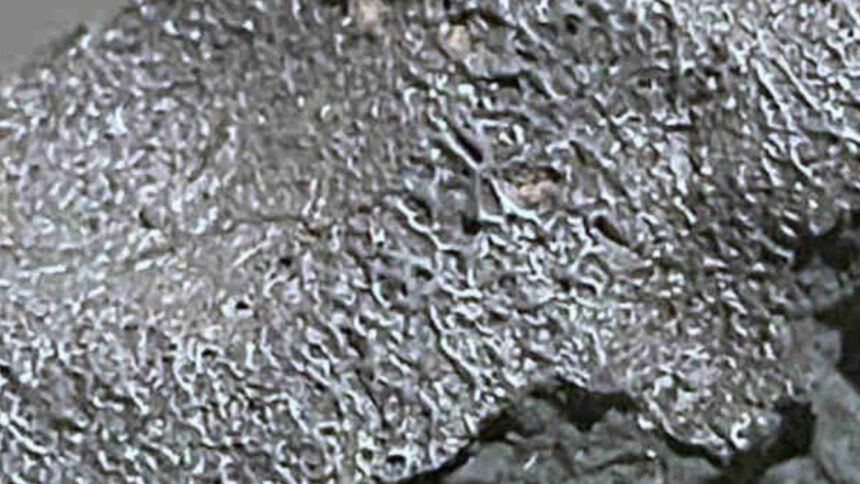
A meteorite that crashed through the roof of a New Jersey home is helping scientists unlock new secrets about ancient water in our solar system. The space rock, weighing just over one kilogram (2.2 pounds), struck the house two years ago. Today, it is the focus of a groundbreaking study that could provide key insights into the origins of the essential building blocks of life.
The event occurred on July 16, 2024, when residents across New York, New Jersey, Connecticut, Rhode Island, and Pennsylvania reported seeing a bright daytime fireball streak across the sky. The object passed near the Statue of Liberty, generating a powerful sonic boom that was felt by people throughout New York and New Jersey.
Roughly the size of a large carry-on suitcase, the meteor entered Earth’s atmosphere at approximately 32,000 miles per hour (14.4 km/s) before breaking apart at an altitude of about 22 miles (35 km). Weather radar at Newark Liberty International Airport captured a cloud of falling debris spreading from Staten Island into New Jersey.
The meteorite that ended up in a bedroom
Unlike typical meteorites, this space rock was extremely fragile. Only one fragment was successfully recovered after it crashed through the ceiling of a master bedroom in Hillsborough, New Jersey.
No one was injured in the impact. The homeowners acted quickly, using disposable gloves, aluminum foil, and glass jars to carefully collect the dark fragments and dust scattered across the bed and carpet.
Even more importantly, they repaired the damaged roof before rain arrived that evening. That quick response proved crucial because the meteorite was porous, meaning exposure to rain or humidity could have contaminated the sample and compromised scientific analysis.
Wildfire smoke blankets World Cup final venue
A window into the early solar system
The study, published in the journal Science Advances, determined that the Hillsborough meteorite belongs to a rare class of space rocks known as CM½ carbonaceous chondrites—essentially a time capsule from the early solar system.
Researchers discovered a complex combination of amino acids, the fundamental building blocks of proteins, along with other organic compounds and hydrated minerals.
“Most of the amino acids detected in Hillsborough are rare or nonexistent in terrestrial life, proving they have a genuinely extraterrestrial origin,” explained NASA scientist Danny Glavin, one of the study’s co-authors.
Scientists also identified high concentrations of sodium, likely originating from ancient brines inside the asteroid that produced the meteorite. According to researchers, as water evaporated on the parent asteroid, it left behind mineral deposits capable of forming molecules linked to the chemical processes that helped make life possible.
Blue Angels jet shocks Florida beachgoers with dangerously low pass as Navy reviews maneuver
Connecting the dots to the origins of life
Carbonaceous chondrites are considered crucial pieces of the puzzle in understanding how early Earth received water and organic material. The Hillsborough meteorite reinforces the theory that meteorite impacts may have delivered some of the essential ingredients needed for life to emerge on our planet.
Peter Brown, a professor of physics and astronomy at Western University, emphasized that the discovery of ancient brines provides an important clue into how water interacted with minerals and organic compounds during the earliest stages of the solar system.
“Anything we can learn about how water transformed these primitive meteorites is fundamental to astrobiology and to understanding the earliest biological processes on Earth,” Brown said.
A cosmic journey that ended in New Jersey
The recovered fragments of the Hillsborough meteorite are now preserved at the American Museum of Natural History in New York, where scientists continue studying them.
The homeowners, who chose to remain anonymous, said they still find it difficult to believe that a rock traveling through space for millions of years ultimately ended its journey inside their home.
“We knew almost immediately that what happened was extremely rare, and we felt a deep responsibility to preserve the meteorite for the scientific community,” they said.
For researchers, this extraordinary discovery shows that even an unexpected crash in a suburban bedroom can become a once-in-a-lifetime opportunity to understand how the solar system evolved—and where the ingredients for life came from.
Disclaimer: This content has not been generated, created or edited by Finance SC. Publisher:
Source link
Source link