



Hey folks!
You know the drill. You’re trying to buy concert tickets or log into your bank and suddenly you’re being asked to identify every traffic light in a blurry grid of nine images. You click, maybe second guess yourself, ask a friend for help and then finally submit.
That’s a CAPTCHA. And it’s been around since 2000.
The original idea was elegant in its simplicity: give users a task that humans find easy but computers find hard. That included distorted text, scrambled numbers, fuzzy audio clips. The assumption was that machines couldn’t read what humans could.
Then computers got better at reading. So the tests got harder; enter the era of fire hydrants, bicycles, and crosswalks. But here’s the thing. Every time a CAPTCHA got harder for bots, it also got harder for humans. And the bots kept catching up anyway.
Now, modern AI can crack image-based CAPTCHAs faster and more accurately than most people. The test designed to prove you’re human has become one that humans are increasingly more likely to fail. Ironic, isn’t it?
So Google is trying something new. Last month, it started testing a CAPTCHA that asks users to record a short video of their hand gestures. Algorithms track 21 points across your hand and finger joints to determine if you’re real. And security researchers have already found a workaround, using nothing more than a photo of a hand!
Meanwhile, other approaches are taking over from behind the drapes. Behavioural analysis systems now track your mouse movements, clicking patterns, and device fingerprints in the background; no puzzle required. You don’t see it happening, the website just decides whether to let you in.
So while the internet spent 26 years asking you to prove you’re human. The next version might not ask at all, it’ll just watch how you move and decide for itself.
Whether that’s better or worse probably depends on how much you trust who’s watching. What do you think?
Here’s a soundtrack to put you in the mood… 🎵
Rim Jhim by Ustad Rashid Khan
You can thank our reader, Sankarshan Verma, for this recommendation. Sankarshan has also added some context for us with his rec. He writes,
The song is composed in Raag Malhar, which is traditionally sung during the monsoon season. I like both Rashid Khan’s vocals and the song’s composition.
Though Rashid Khan is popular for singing “Aaoge Jab Tum O Saajna” in Jab We Met, he has a much more distinguished record as an Indian classical singer.
Also folks, keep your music recommendations coming. We’d love to feature them in our Sunday editions, especially gems from underrated Indian artists many of us haven’t discovered yet. Can’t wait to hear them!
Ready to roll?
What caught our eye this week
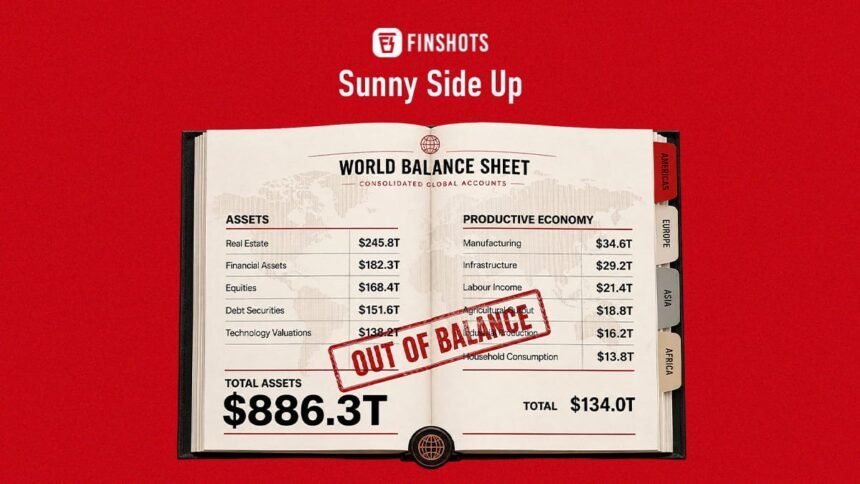
The world’s balance sheet doesn’t seem to balance
Have you ever wondered what the world’s balance sheet looks like?
Not India’s or Reliance’s. The entire planet’s.
Turns out, someone actually did the math. This week, McKinsey rolled out a report which said that the world’s balance sheet hit a record $1.8 quadrillion in 2025, up 6% from 2024.
Yes, quadrillion! That’s 1,000 trillion. Global household wealth also climbed to $570 trillion, an increase of $40 trillion.
So… we’re all rich now, right?
Well, not quite.
See, just like companies, the global economy has a balance sheet. On one side are the things it owns like homes, factories, roads, machines, stocks, bonds, cash, and deposits. On the other side are the things it owes, stuff like debt, liabilities, and other claims. Subtract the liabilities from the assets, and you’re left with wealth, or net worth.
This means that a balance sheet isn’t just about how many assets you own. It’s also about why those assets are worth what they are. You could think of it like this. If a family owns a house and some stocks and both suddenly double in value, the family’s net worth shoots up overnight. That sure means they’re wealthier but only on paper because they didn’t earn or save more. Their assets simply became more expensive.
The same thing has happened to the global economy. A large chunk of the increase in global wealth over the past few years has come from rising asset prices rather than from building more productive capacity like factories, infrastructure, businesses, or technologies that generate future income.
Simply put, the balance sheet has grown. But not necessarily because the real economy has kept pace.
To put that in perspective, the US and China are driving much of the world’s wealth, but in very different ways.
In the US, for instance, equities surged to 2.4 times corporate net assets. And just over half of the S&P 500’s market value growth between 2021 and 2025 came from the “Magnificent Seven” companies — Alphabet, Amazon, Apple, Tesla, Meta, Microsoft, and NVIDIA, closely tied to the AI boom.
China has a different story. It’s more about debt and property. Corporate debt climbed to about 1.7 times GDP (Gross Domestic Product, or the total value of all goods and services a country produces), the highest among major economies, even as property values remained under pressure.
So while the US is being powered by soaring stock prices, China is being shaped by a debt-heavy corporate sector and a weak housing market.
Real estate, meanwhile, is still the biggest piece of the global balance sheet. But in many countries, it has cooled from its pandemic-era highs and has declined relative to GDP. Australia was an exception, with real estate values reaching 4.5 times GDP.
In the end, you could say the world isn’t just getting wealthier, but also more uneven. Some of that growth is backed by real investment and productivity. But a lot of it is still being driven by rising valuations, debt, and optimism. And that’s fine until prices run too far ahead of incomes.
So what would it take to bring the world’s balance sheet back into balance, you ask?
Maybe the answer is to produce more things, build more useful capacity and let wealth grow from the real economy instead of relying on rising asset prices and debt. Because that’s what creates a difference between a balance sheet that looks strong and one that actually is strong.
Readers Recommend
This week, our reader Ishan Shukla recommends reading The Richest Man in Babylon by George S. Clason.
Ishan writes,
Originally published in 1926, it’s a timeless classic that teaches the principles of wealth creation and financial independence through engaging parables set in ancient Babylon. The slightly old-world English adds to its charm, and its lessons on saving, investing, and building wealth remain just as relevant today as they were nearly a century ago.
Thank you for the rec, Ishan!
That’s it from us this week. We’ll see you next Sunday.
Until then, send us your book, music (preferably from underrated Indian artists), business movies, documentaries, or podcast recommendations. We’ll feature them in this newsletter! Also, don’t forget to tell us what you thought of today’s edition. Just hit reply to this email (or if you’re reading this on the web, drop us a message at morning@finshots.in).
Don’t forget to share this edition on WhatsApp, LinkedIn and X.
Disclaimer: This content has not been generated, created or edited by Finance SC. Publisher:
Source link
Source link