



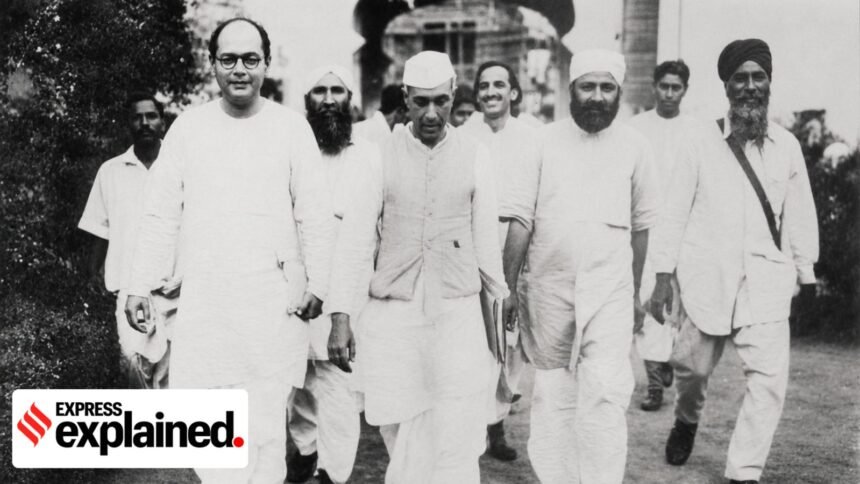
The Congress Working Committee (CWC) has decided that only the first two stanzas of Vande Mataram will be sung at party programmes, amid BJP attacks over the National Song’s rendition at its Independence Day programme and later at an event in Goa.
The Congress’s highest decision-making body cited a 1937 CWC resolution to back its stand, arguing that the leading lights of the freedom movement, including Mahatma Gandhi and Rabindranath Tagore, had backed limiting the public rendition of Vande Mataram to its first two stanzas.
The row comes months after Parliament made intentional attempts to prevent or disrupt the singing or playing of Vande Mataram an offence.
Why did the Congress in 1937 distinguish between the first two stanzas and the rest of the song? What do the remaining four stanzas say, and why have they been contentious?
The composition
Vande Mataram (meaning ‘mother, I bow to thee’) was composed in Sanskritised Bengali by Bankim Chandra Chattopadhyay in 1875. Six years later, it was included in his novel Anandamath, which tells the story of the late-18th century Sanyasi Rebellion — a series of armed uprisings in Bengal against the East India Company rule and the regional Muslim administrators.
Vande Mataram gained popularity during the Swadeshi movement (1905-08), becoming closely associated with the freedom struggle.
The Muslim League, however, was against some references in the song, and also believed that “bowing to the mother” amounts to idolatry.
The 1937 decision
Story continues below this ad
Within the Congress, there was a discussion about the Vande Mataram issue. Several people, including Subhas Chandra Bose (who supported the song wholeheartedly) and Jawaharlal Nehru, wrote to Tagore to seek his opinion.
Tagore wrote to Nehru: “To me the spirit of tenderness and devotion expressed in its first portion, the emphasis it gave to beautiful and beneficent aspects of our motherland made a special appeal, so much so that I found no difficulty in dissociating it from the rest of the poem…”
He added: “I freely concede that the whole of Bankim’s ‘Vande Mataram’ poem, read together with its context, is liable to be interpreted in ways that might wound Moslem susceptibilities, but a national song, though derived from it, which has spontaneously come to consist only of the first two stanzas of the original poem, need not remind us every time of the whole…” [From Sabyasachi Bhattacharya’s book, Vande Mataram: The Biography of a Song].
In October 1937, the Congress Working Committee had decided that when Vande Mataram is sung at national gatherings, only the first two stanzas should be sung, as the other “stanzas of the song are little known and hardly ever sung. They contain certain allusions and a religious ideology which may not be in keeping with the ideology of other religious groups in India”.
Story continues below this ad
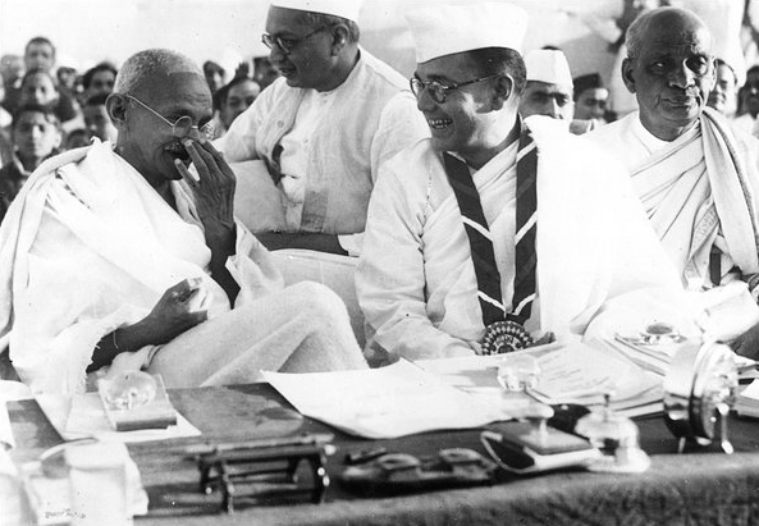 Mahatma Gandhi at the Indian National Congress annual meeting in Haripura in 1938. Congress President Subhas Chandra Bose is wearing the ribbon, seated behind him is Dr Rajendra Prasad, and to the right of Bose is Sardar Vallabhbhai Patel. (Photo: Wikimedia Commons)
Mahatma Gandhi too, while expressing admiration for the song, said it should not be sung at gatherings where people objected to it. On July 1, 1939, he wrote in Harijan: “It was an anti-imperialist cry… It had never occurred to me that it was a Hindu song or meant only for Hindus. Unfortunately, now we have fallen on evil days… I would not risk a single quarrel over singing Vandemataram at a mixed gathering.”
The same month, he again wrote in Harijan that “if at any mixed gathering any person objected to the singing of Vandemataram even with the Congress expurgations, the singing should be dropped.” [Mahatma Gandhi and the Harmony of Music, By Teresa Joseph & AM Thomas].
Why the later stanzas are contentious
The opposition to Vande Mataram from Muslim scholars is rooted in the interpretation that the song’s imagery of “Mother India” as a goddess violates the basic Islamic tenet of strict monotheism, which forbids followers from worshipping anyone other than Allah.
The third stanza talks about “crores and crores” of arms ready to bear swords in the defence of the motherland, while the fourth says the motherland’s image is carved out in every shrine, and the fifth likens the motherland to goddesses Durga, Lakshmi and Saraswati. This invocation of Hindu goddesses has sparked objections from Muslim scholars.
Story continues below this ad
The latter parts of the song, according to historian Tanika Sarkar, “become a call to war where Muslims are the adversary in the Anandmath, and the motherland here acquires the form of a Hindu goddess that alienates Muslims”.
The political debate
When India gained Independence, there was a demand for Vande Mataram to be adopted as the national anthem. In the Constituent Assembly, there was some friction on the issue. On August 14, 1947, at the Assumption of Power ceremony, Sucheta Kripalani sang the first verse of Vande Mataram as the opening item. On August 26, HV Kamath rose in the Assembly to say that on that day: “…Some of us in this House noticed that a number of our Honourable friends entered the Assembly Chamber — I would almost say trooped into this Hall — after the song had been sung. I would request you, Sir, to look into this matter…”
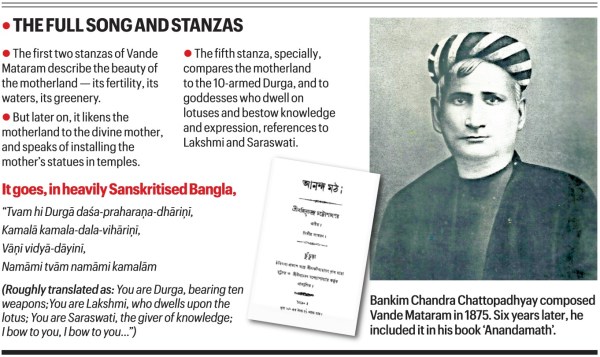 The song and its stanzas
Among those who preferred Jana Gana Mana as the anthem were Nehru, and among the reasons he cited was that Vande Mataram would be difficult to set to an orchestra. On November 5, 1948, Seth Govind Das said in the Constituent Assembly: “…I would say that ‘Vande Mataram’ can be our National Anthem. The history of our struggle for independence is associated with Vande Mataram. If it be said that is tune is not fit for orchestrisation I would submit that this is a difficulty which can be overcome by experts in orchestral music.”
Jana Gana Mana was eventually chosen as the anthem.
On January 24, 1950, President Rajendra Prasad told the Constituent Assembly: “The composition consisting of the words and music known as Jana Gana Mana is the National Anthem of India, subject to such alterations in the words as the Government may authorise as occasion arises; and the song Vande Mataram, which has played a historic part in the struggle for Indian freedom, shall be honoured equally with Jana Gana Mana and shall have equal status with it. I hope this will satisfy the Members.”
Story continues below this ad
The BJP has recently made a major push to sing all six stanzas of the song. The Ministry of Home Affairs on January 28 notified the first set of protocols for singing Vande Mataram, directing that all six stanzas shall be sung during official functions.
The BJP has long accused the Congress of giving in to its “appeasement politics” over Vande Mataram’s truncation.
Now, the Congress’s stand comes at a time Parliament has passed the Prevention of Insults to National Honour (Amendment) Act, 2026, which amends Section 3 of the Prevention of Insults to National Honour Act, 1971 to extend the same legal protection to the Vande Mataram that the National Anthem, Jana Gana Mana, enjoys. The amendment makes it an offence to intentionally prevent the singing of the National Song or to cause a disturbance to an assembly engaged in its singing.
Congress general secretary Jairam Ramesh told The Indian Express: “Dr. Rajendra Prasad as President of the Constituent Assembly announced on Jan 24 1950 that Vande Mataram (first two stanzas) will be the national song… This was accepted by the Constituent Assembly with cheers. But in December 2025, Parliament only had a discussion and never ever adopted a resolution saying that the full Vande Mataram will be the national song. This was a unilateral decision of the PM and HM by notification, which does not have Parliamentary approval.”
Disclaimer: This content has not been generated, created or edited by Finance SC. Publisher:
Source link
Source link