



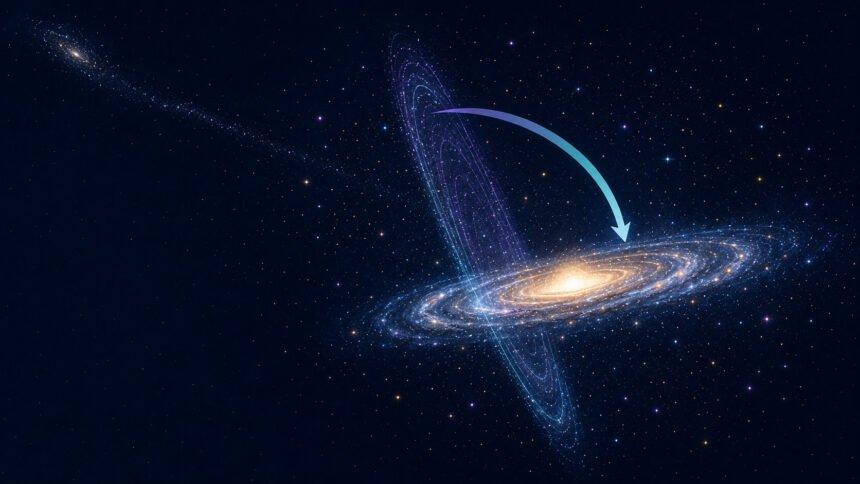

The Milky Way may have once performed a colossal, slow-motion somersault. Its starry disc appears to have swung through more than 90 degrees, leaving behind a faint signature that astronomers can still detect billions of years later.
The clue lies beyond the familiar spiral arms, in a sparse cloud of ancient stars known as the stellar halo. While the Milky Way’s disc races around at roughly 220 kilometres per second, this halo rotates at only around 10 to 20 kilometres per second.
The difference puzzled astronomers for years.
At the 2026 National Astronomy Meeting, Durham University researcher Kirill Batrakov presented a likely (and stunning) explanation for it.
“We already know that the Milky Way had a massive head-on collision in the past with a galaxy known as Gaia-Sausage-Enceladus (often simply called the Gaia Sausage). So, we think that the Milky Way disc likely flipped in the past,” Batrakov told ZME Science.
A halo that barely turns
Batrakov and his colleagues can’t observe the flip directly; no telescope can film an event that may have unfolded billions of years ago. Instead, they studied the histories of simulated Milky Ways and identified the events shared by those with unusually slow stellar haloes.
The stellar halo contains only a small fraction of the Milky Way’s stars, but it carries an unusually rich history. Many halo stars once belonged to dwarf galaxies that ventured too close, were torn apart and became part of the Milky Way.

Their motions preserve some of the angular momentum carried by those vanished galaxies. The stellar halo therefore acts as a rough sum of the Milky Way’s ancient accretion events—a sort of astronomic fossil record written not in stone, but in moving stars.
Astronomers quantified its slight spin in a 2017 study led by Alis Deason, now one of Batrakov’s supervisors and a co-author of the new work. The team combined early Gaia measurements with older Sloan Digital Sky Survey images, allowing it to track several kinds of distant halo stars. The researchers measured an average prograde rotation of 14 kilometres per second. “Prograde” means that the halo turns in the same general direction as the disc, only far more slowly.
Batrakov used something called the Auriga simulations, which recreate how galaxies grow as they form stars, draw in gas and absorb smaller galaxies. He traced how their stellar haloes rotated over the past 11 billion years, searching for the events that could explain why the Milky Way’s halo turns unusually slowly.
“We’ve seen in the observations of the Milky Way that it rotates much slower than what we typically see in the simulations,” Batrakov told ZME Science in an interview. “So we just wanted to try to explain why. Why could this be? What are possible explanations?”
The galaxy that became a sausage

Gaia–Sausage–Enceladus is the name given to the remains of a dwarf galaxy that collided with the young Milky Way roughly 8 billion to 11 billion years ago. Astronomers identified it through the chemistry and peculiar motions of stars scattered across today’s halo.
Those stars do not move around the Milky Way on orderly, nearly circular paths. They plunge inward and outward on highly elongated orbits. When astronomers plot their velocities, the population forms a stretched shape that inspired the “Sausage” nickname.
But the word “collision” can create the wrong mental image, says Batrakov. Galaxies contain enormous numbers of stars, but the distances separating those stars are so great that two galaxies can pass through one another without producing a barrage of direct stellar impacts.
“I guess we call it a collision, but it’s not like we would imagine collision of two objects on the Earth,” Batrakov said. “So, for example, it’s not the same as two balls colliding with each other because the smaller galaxy, the satellite which is being absorbed by the larger galaxy, it eventually mixes throughout the bigger galaxy.”

Rather, it’s gravity that does the damage. It stretches the smaller galaxy, strips away its stars and deposits them along new trajectories. Gas clouds can collide and compress, while the changing gravitational field can warp or reorient the larger galaxy’s disc.
The researcher says they can’t be “100% certain” that this is happening, but according to the simulations, this type of collision is the most likely scenario.
In Batrakov’s analysis, present-day stellar haloes rotated more slowly when their simulated galaxies had experienced a Gaia–Sausage-like merger. They also rotated slowly when their discs had flipped, but the current abstract does not establish that the ancient merger necessarily caused the entire flip.
How to flip a galaxy
Space has no “up” or “down,” so we have to define what a flip actually is. Here, the researchers followed the disc’s angular-momentum vector, an imaginary arrow pointing along its axis of rotation. Based on that, a “flip” is a rotation of over 90 degrees.
So the galaxy didn’t turn like a rigid dinner plate. Rather, its stars continued orbiting while gravity gradually redirected the disc, disrupted parts of it, and allowed material to settle into a new orientation.
This process also took a long time.
“I think the quickest flip was about 150 million years,” Batrakov said, adding that the longer ones were likely 1-2 billion years. “So it is not an instantaneous process. It takes quite a while, as everything in astronomical processes.”
The Earth didn’t exist back then, but even if it did, the event may not have been detectable to life on our planet. The Sun would follow the majority of the disk, most likely.

Other studies have independently found hints that the Milky Way’s orientation changed. In 2026, researchers led by Ling Zhu used motions from more than 600,000 giant stars observed by Gaia and the LAMOST telescope to reconstruct the likely shape of the galaxy’s dark-matter halo. Their study concluded that the outer dark-matter halo appears oriented almost vertically to the stellar disc. Comparisons with simulated galaxies suggested that the inner halo and disc may have tilted while the outer halo retained an older orientation.
For a more detailed “forensic” analysis, astronomers will now need to identify other scars that a large reorientation should leave behind. They can search for changes in halo rotation with distance, stellar age and chemistry, or for mismatches between the orientations of the disc, stellar halo and dark matter. Batrakov described that search as a possible future project.
However, establishing which signatures survive a flip, he said, and then finding them in the real Milky Way “would be a whole different research project.”
The results are described in the official NAM2026 abstract and have not yet been peer-reviewed.
Disclaimer: This content has not been generated, created or edited by Finance SC. Publisher:
Source link
Source link