



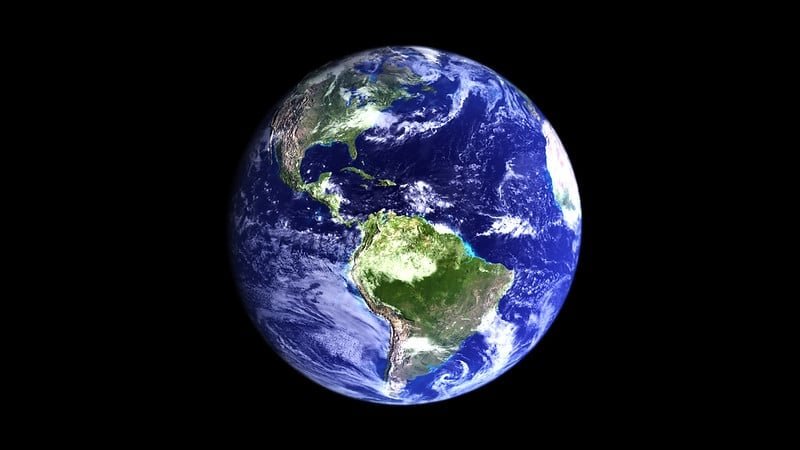

Earth’s recent period of unusually fast rotation may be easing, according to scientists tracking the planet’s spin. After several years of record-breaking short days, researchers expect the shortest day of 2026 to occur on Sunday, July 26.
Although Earth is still rotating slightly faster than its long-term average, the difference is expected to be much smaller than the extremes recorded in recent years.
The latest projections suggest the period of unusually rapid rotation may be slowing, though scientists say more observations are needed to confirm a long-term trend.
The International Earth Rotation and Reference Systems Service (IERS), the organization that keeps global time aligned with Earth’s rotation, projects that July 26 will be about 0.65 milliseconds shorter than the standard 24-hour day.
While people will not notice the difference, these tiny changes matter for technologies that depend on highly accurate timing, including satellite navigation, telecommunications, financial trading systems and atomic clocks.
Scientists track shorter days
A standard day lasts exactly 86,400 seconds, or 24 hours. In reality, Earth’s rotation is never perfectly constant. Movements within the planet, along with changes in the atmosphere, oceans and the moon’s gravitational pull, cause the length of a day to vary by tiny fractions of a second.
Scientists first detected a clear shift in 2020, when Earth recorded 28 of the shortest days ever measured since atomic clocks came into use. The trend reached its peak on July 10, 2025, when the planet completed one rotation 1.37 milliseconds faster than the standard 24-hour day, making it the shortest day on record.
Earth’s unusually fast rotation may be slowing after years of record-breaking short days. Scientists expect the shortest day of 2026 on July 26, about 0.65 milliseconds shorter than 24 hours. pic.twitter.com/BGEMUWczwC
— Tom Marvolo Riddle (@tom_riddle2025) July 24, 2026
The projected 0.65-millisecond difference for July 26, 2026, suggests the period of record-breaking speed may be easing. Leonid Zotov, a geodesy specialist at Moscow State University, said the recent measurements indicate Earth’s fastest rotation may already have passed. “The deepest minimum over the past decade has been passed: Earth has passed its highest velocity.”
Natural forces influence Earth’s rotation
Researchers say several natural processes constantly influence Earth’s rotation. Over long periods, the moon’s gravity gradually slows the planet through tidal friction, the force created by ocean tides. Short-term changes occur as the moon shifts position in its orbit and as Earth’s liquid outer core, oceans and atmosphere redistribute mass around the planet.
Climate change is adding another influence
Climate change is also becoming a measurable influence. A study published earlier this year by researchers from the University of Vienna and ETH Zürich found that melting glaciers and polar ice sheets are moving vast amounts of water from the poles toward the equator.
That shift changes Earth’s moment of inertia, causing the planet to spin slightly more slowly. Scientists often compare the effect to a figure skater extending their arms to reduce their spinning speed. Researchers say this redistribution of mass may be helping offset the unusually fast rotation observed in the early 2020s.
Why milliseconds matter
Although the changes are measured in milliseconds, they have important consequences for global timekeeping.
For decades, timekeepers occasionally added a leap second to Coordinated Universal Time (UTC) to keep atomic clocks synchronized with Earth’s rotation. As the planet began spinning faster in recent years, scientists raised the possibility of an unprecedented negative leap second, which would remove a second instead of adding one.
Such a change could create problems for software, communications networks, GPS systems and high-speed financial trading platforms that rely on uninterrupted, precisely synchronized timestamps.
Researchers say the projected slowdown in 2026 reduces the immediate need for a negative leap second, offering temporary relief for engineers responsible for keeping the world’s digital infrastructure synchronized with Earth’s changing rotation.
Disclaimer: This content has not been generated, created or edited by Finance SC. Publisher:
Source link
Source link