


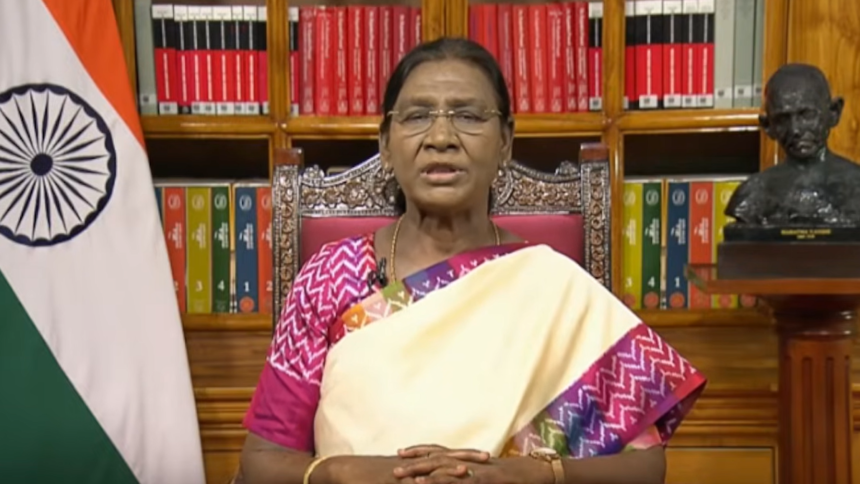
President Droupadi Murmu on Friday (August 14, 2026) described students as the “architects of India’s future” and with 65% of the population below the age of 35, India’s youth were its “most valuable asset”.

In her address to the nation on the eve of the 80th Independence Day, she said the government was undertaking comprehensive reforms to make public examinations transparent, secure and trustworthy, and to completely curb paper leaks and the use of unfair means.
“Public examinations become gateways to opportunities for our students,” Ms. Murmu said, stressing that the government and society had a shared responsibility to safeguard the present and future of young Indians.
Her remarks assume significance against the backdrop of the recent student-led protests over demands for systemic reforms following irregularities and paper leaks in competitive examinations.

The President said India’s demographic dividend was its greatest strength, with young people increasingly moving beyond the pursuit of jobs to entrepreneurship and job creation.
The country’s expanding start-up ecosystem, she said, reflected the talent and dedication of its youth. Major global enterprises were impressed by the talent of Indian youth and entrusted them with leadership roles, she added. “Our younger generations strengthen my faith in India’s bright and prosperous future,” she said.
Ms. Murmu stressed the importance of the physical and mental well-being of young people, saying families and society had a collective responsibility to motivate and support them. Sports, she said, had emerged as an important vehicle for youth development and nation-building, with the Khelo India programme building an ecosystem from the grassroots to the national level.
Hails Operation Sindoor
National security featured prominently in the address. Praising the “unmatched valour” of the armed forces, she cited Operation Sindoor as an example of India’s ability to conduct precision counter-terror operations. It had sent a “clear and firm message” to terrorists and their supporters that they would face the consequences of their actions.
She described the suspension of the Indus Waters Treaty as a “decisive step” in the national interest, particularly that of farmers. On internal security, she termed the progress towards making India “Naxal-free” a major achievement, noting that areas once affected by Left-wing extremism were witnessing development and greater community participation.
Talking about India’s civilisational heritage, she referred to the inclusion of Sarnath in the UNESCO World Heritage List this year and said India had demonstrated that its spiritual heritage and history of military strength could be celebrated together.
On foreign policy, she reiterated India’s commitment to peace, dialogue and cooperation, rooted in the principle of Vasudhaiva Kutumbakam (the world is one family). India would continue to seek greater representation for the Global South in the United Nations and other multilateral institutions, she added.
The President highlighted the changing demographic profile, with India witnessing a rise in its elderly population alongside its large young population. Around six crore people aged 70 and above could now avail themselves of free healthcare services of up to ₹5 lakh a year under government initiatives, she said.
Ms. Murmu said India was moving towards Viksit Bharat by 2047, driven by economic resilience, digital infrastructure and the empowerment of youth and women. Despite global conflicts and economic uncertainty, India remained the fastest-growing major economy, while Atmanirbhar Bharat had strengthened the foundations of economic progress and national security, she said.
She cited welfare and financial-inclusion milestones, saying more than 25 crore people had been lifted out of poverty, nearly 59 crore had entered the banking system through the Pradhan Mantri Jan Dhan Yojana – with over 32 crore account holders being women – and over 80 crore people were receiving free foodgrains. She said India accounted for more than half of global real-time digital transactions.
Women’s empowerment – a key theme
Women’s empowerment remained another key theme, with the President referring to the Nari Shakti Vandan Adhiniyam to provide a one-third reservation for women in the Lok Sabha and State Assemblies and make Indian democracy more inclusive, the target of creating three crore new lakhpati didis, women flying fighter combat aircraft and ‘drone didis’ in the agriculture sector.
On sustainable development, she said India had achieved several Sustainable Development Goals ahead of the 2030 deadline and urged citizens to take individual responsibility for protecting the environment, citing initiatives such as Ek Ped Maa Ke Naam and Lifestyle for Environment.
Paying tribute to freedom fighters Mahatma Gandhi, B. R. Ambedkar and Sardar Vallabhbhai Patel, she also remembered those who died or were displaced during Partition, observed on August 14 as Vibhajan Vibheeshika Smriti Divas.
Quoting Telugu writer Gurajada Apparao — “A nation is not just its land, a nation is all its people” — Ms. Murmu called upon citizens to contribute to transforming independent India into a developed nation by 2047.
Published – August 14, 2026 07:10 pm IST
Disclaimer: This content has not been generated, created or edited by Finance SC. Publisher:
Source link
Source link