



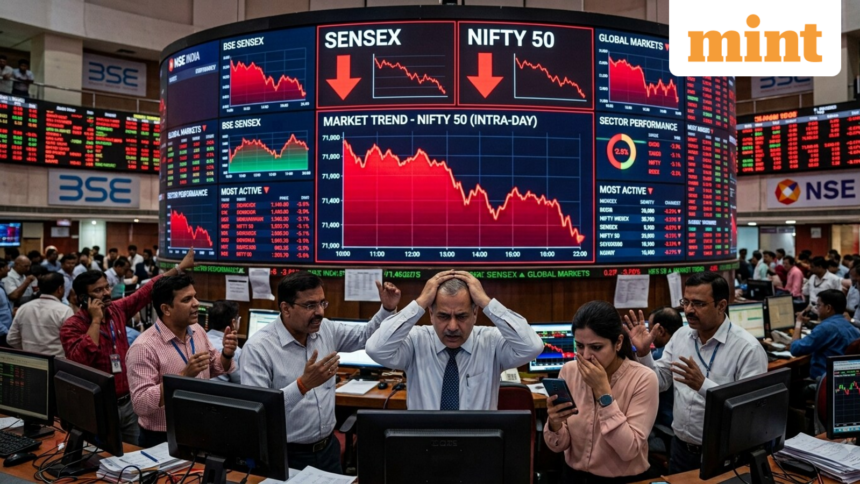
The Indian stock market remained in negative territory for the second consecutive session, with the benchmarks, the Sensex and the Nifty 50, witnessing strong intraday volatility on Wednesday, 12 August.
The Sensex and the Nifty 50 dropped almost 1% each during the session but pared most losses to end with minor cuts.
The 30-share pack ended 188 points, or 0.24%, lower at 77,966.35, while the NSE counterpart Nifty 50 settled at 24,435.95, down 36 points, or 0.15%.
The mid and small-cap segments ended mixed; Nifty Midcap 100 rose by 0.28%, while the Smallcap 100 index declined 0.18%.
In two sessions, the Sensex has retreated nearly 600 points, or 0.70%, while the Nifty 50 has declined 0.60%.
Investors lost about ₹2 lakh crore in two days, as the overall market capitalisation of BSE-listed firms dropped to ₹492 lakh crore from ₹494 lakh crore on 10 August.
Why did the stock market fall today?
Here are five key factors behind the fall in the Indian stock market:
1. Middle East confusion
The market is reacting negatively to the persistent uncertainty about the reopening of the Strait of Hormuz and a potential US-Iran peace deal. While Iran has said the Strait of Hormuz will remain closed until the US agrees to its conditions, US President Donald Trump has said the US is ‘in total control’ of the crucial waterway.
Meanwhile, reports of sporadic strikes in the region continue to percolate. Yemen’s coastguards have revealed that six individuals were killed in a Houthi attack on a cargo ship in the Bab el-Mandab Strait. The US Central Command has said that it fired two missiles at a container ship in the Gulf of Oman.
2. Elevated oil prices
Elevated oil prices have rekindled concerns that inflation will remain above central banks’ tolerance bands, prompting interest rate hikes.
Brent crude rose 1% to trade near $90 per barrel on Wednesday as uncertainties about a US-Iran peace deal and attacks on two ships drove concerns about disruptions in supplies from the region.
“The principal factor restraining a rally is the strengthening Brent crude, which has again moved above the $89 level. The off-and-on skirmishes between the U.S. and Iran continue with the latest attack by the U.S. military on a Panama-flagged container ship. Iran now appears to be hardening its stance on the opening of the Strait of Hormuz. This might keep crude prices elevated, constraining a rally in the market,” VK Vijayakumar, Chief Investment Strategist, Geojit Investments, noted.
Higher oil prices can strain India’s fiscal position, widen its current account deficit, weaken the domestic currency, drive up inflation, lead to interest rate hikes, weigh on corporate profitability, and trigger foreign capital outflows.
3. Caution ahead of key inflation prints
To some extent, caution ahead of key inflation prints in the US and India has also contributed to the market’s downtrend. Consumer Price Index (CPI)-based inflation data for July is due in India and the US later today, which will influence expectations about monetary policy from the US Federal Reserve and the Reserve Bank of India.
Both the US Fed and the RBI maintained a status quo on benchmark interest rates in their recent policy decisions. However, concerns are rife that oil price-driven inflation can push them to bite the bullet and raise rates in the near future if the Middle East conflict is not resolved soon.
US CPI is expected to come in at 3.4% compared to 3.5% in June, while India CPI may climb further to 4.50% from 4.38% in June.
4. Profit booking in select heavyweights
TCS, L&T, Mahindra and Mahindra, Infosys, and Eternal ended as the top drags on the Sensex index.
Among sectors, BSE IT, FMCG, and Healthcare dropped up to 1%. However, BSE PSU Bank jumped 1.86%, supported by strong asset quality, attractive valuations, and expectations of healthy credit growth.
5. Technical factor
Nifty has fallen below 24,450, eyeing the next support near 24,300.
Sudeep Shah, the head of technical and derivatives research at SBI Securities, said the immediate resistance for Nifty is placed in the 24,570-24,600 zone.
He added that any sustainable move above this zone could result in Nifty extending its pullback towards 24,750, followed by 24,900 in the short term. On the downside, the immediate support for Nifty is placed in the 24,300-24,270 zone.
According to Bajaj Broking, 24,200–24,300 remains the immediate support zone for the Nifty 50, supported by the previous gap area and the 50-day EMA. Key short-term support is placed at 24,000.
Read all market-related news here
Read more stories by Nishant Kumar
Disclaimer: This article is for educational purposes only and does not constitute investment advice. The views and recommendations expressed are those of individual analysts or broking firms, not Mint. We advise investors to consult with certified experts before making any investment decisions, as market conditions can change rapidly and circumstances may vary.
Disclaimer: This content has not been generated, created or edited by Finance SC. Publisher:
Source link
Source link