



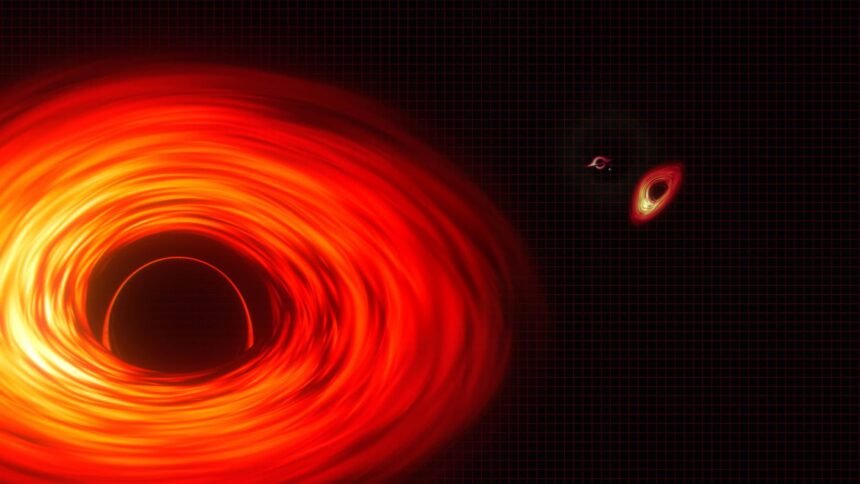

A new analysis of gravitational-wave detections suggests that roughly 14% of merging binary black holes belong to a second generation. In other words, at least one member of these systems may itself be the remnant of an earlier black hole collision.
“We’re finding that, for some of these merging black holes, it’s not their first rodeo,” said Cailin Plunkett, a graduate student in MIT’s Department of Physics and the study’s first author. “The question of how often are they repeatedly merging was pretty uncertain. Now we’re seeing a relatively consistent picture where there’s a decent percentage of black holes that are coming from this repeated pathway.
An MIT-led team combed through 155 mergers detected by the LIGO, Virgo, and KAGRA observatories and found that roughly 14% appear to be “second-generation” — the offspring of earlier collisions between smaller black holes. In some crowded corners of the universe, black holes are building themselves through repeated wrecks, growing bigger with each round.
The work offers the sharpest statistical portrait yet of what astronomers call “hierarchical mergers“, and may finally explain where some suspiciously chunky black holes came from.
Black holes with a past
Most stellar-mass black holes begin with the collapse of massive stars. Some collapses produce spectacular supernovae. Others may result in weak explosions or no bright explosion at all.
But this is only the first generation. Black holes can only be born through collisions. The challenge is telling these second-generation black holes apart from those formed directly through stellar collapse. Black holes don’t carry visible scars from earlier collisions.
When two black holes collide, they create a larger remnant. If that remnant remains inside a crowded environment and later captures another black hole, it can merge again. The resulting system is known as a hierarchical merger.
They do, however, spin.

A black hole forged in a single supernova should be born relatively sluggish, because the exploding star flings away most of its angular momentum along with its outer layers. The offspring of a merger would spin faster, as the two masses barrel towards each other and convert their orbital motion into the spin of a single, dizzy successor.
“They would be spinning very fast, at about 70% their maximum possible spin,” said Salvatore Vitale, associate professor of physics at MIT and a co-author on the study.
That spin can be used as a diagnosis method.
A telltale wobble
Before merging, two black holes circle each other in an increasingly tight orbit. When their spins line up with the orbital axis, the orbital plane remains comparatively steady.
But when one or both spins point in a different direction, the orbital plane can precess. That’s a specific type of wobble, somewhat like a spinning top losing its balance. This precession also leaves subtle structure in the gravitational-wave signal. By measuring it, physicists can infer how the black holes’ spins are oriented and how their masses compare.
Plunkett, Vitale, and colleagues Thomas Callister of Williams College and Michael Zevin of the Adler Planetarium and Northwestern University built a population model combining two gravitational-wave measurements. One describes how much of the black holes’ spin points along the orbit. The other captures spin components that contribute to precession.
First-generation pairs should cluster in one region of this combined spin space. Systems containing a merger remnant should trace a broader, curved distribution produced by a rapidly spinning black hole with a more randomly oriented axis.
Two detections made in 2024, GW241011 and GW241110, helped motivate the search. Both involved markedly unequal partners, with one black hole apparently spinning much faster than the other.
Rather than treating those events as isolated curiosities, the researchers searched for the same pattern across the broader population.
The masses form a pattern
The analysis uncovered two especially interesting mass regimes.
The inferred hierarchical-merger fraction reached a low-mass peak when the heavier black hole in a binary weighed about 15.7 times as much as the Sun. The data then indicated relatively few hierarchical systems between approximately 20 and 40 solar masses. But at higher masses, the pattern changed dramatically.
The researchers identified a transition at a primary black hole mass of about 46.2 solar masses. Above that threshold, and within the mass range where the observations provide meaningful constraints, the population was consistent with being dominated almost entirely by hierarchical mergers.
Inside extremely massive stars, the core can become hot enough for energetic photons to transform into electron–positron pairs. This conversion reduces the radiation pressure supporting the star, causing the core to contract and heat even further.
The result can be a violent nuclear runaway. Some stars undergo repeated eruptions that strip away enormous amounts of material. Others are completely disrupted, leaving no black hole behind.
Stellar models therefore predict a shortage of black holes above roughly 40 to 50 solar masses, although the precise boundary depends on the star’s composition and on uncertain details of stellar and nuclear physics.
But black holes assembled from previous mergers face no such restriction. Two smaller black holes can combine to place their remnant directly inside the nominally forbidden range.
Cosmic mosh pits
Hierarchical mergers can’t just happen everywhere.
Across most of a galaxy, stellar-mass black holes are separated by immense distances. Even after two black holes merge, the remnant can receive a recoil kick because gravitational waves carry momentum away unevenly. That kick may eject it from its surroundings before it gets another chance to collide.
Repeated mergers are more plausible in places with many objects packed into a small volume and enough gravity to retain at least some collision remnants.
Dense star clusters provide one possibility. Heavier objects gradually sink toward their centers, where black holes can repeatedly interact, form binaries and collide. Nuclear star clusters surrounding galactic centers may be particularly effective because their stronger gravity makes it harder for merger remnants to escape.
So the story of massive stars creating black holes appears to be increasingly incomplete. Some black holes appear to have more than one parent. A few may eventually have grandparents. And through gravitational waves, astronomers are beginning to reconstruct those hidden family trees.
Disclaimer: This content has not been generated, created or edited by Finance SC. Publisher:
Source link
Source link