



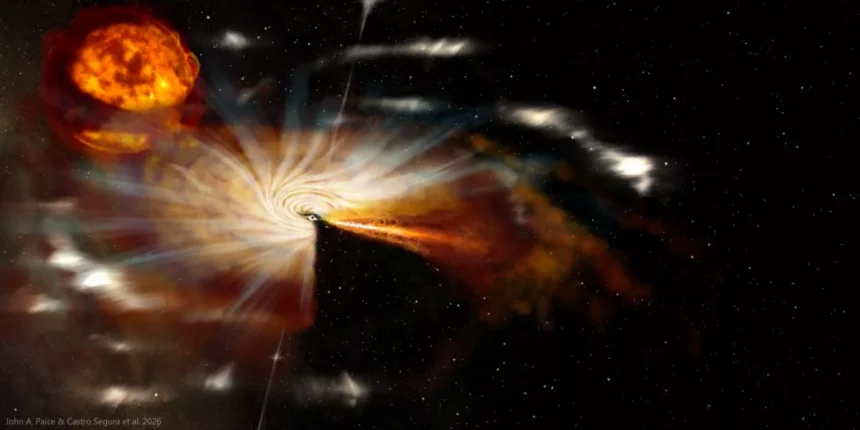
Black holes are often imagined as bottomless pits, swallowing everything that dares to cross their path. But new observations of a dramatic outburst from the black hole system Swift J1727.8−1613 reveal a far more complicated reality, one that looks less like endless consumption and more like a cosmic digestive process.
Swift J1727 suddenly woke up in 2023 and grew into one of the most luminous X-ray sources seen from Earth. It shows a black hole absorbing gas from an accompanying star, producing an immense disk of extremely hot gaseous matter. The Very Large Telescope (VLT) from the European Southern Observatory monitored the eruption in detail like never before.
Instead of a single snapshot, they captured the entire feeding cycle, from the black hole’s brightest frenzy to its fading embers.
“People often imagine black holes simply swallowing everything around them,” said Dr Noel Castro Segura, Postdoctoral Fellow at the University of Warwick. “What we’re seeing is a much more complex process. Matter falls in, the system processes it, and a surprising amount is expelled again.”
Meanwhile, a gas being gobbled up by the black hole was released back into space as it blasted jets and winds of material. Most remarkably, some of the biggest outflows persisted long after the black hole was already nearly one hundredth as bright as it had been at its peak.
This suggests black holes can keep expelling dense gas long after their brightest outbursts, meaning they may be far less efficient eaters than previously thought.
“If black holes can continue shedding material even after their largest outbursts, it means they may be much less efficient eaters than we previously assumed,” Castro Segura explained. “A significant fraction of the meal may never reach the black hole at all.”
The study provides direct evidence of black hole consumption. A neighboring star sheds gas, which falls in and heats the black hole’s disc to X-ray brightness. Most of the material is expelled in jets and winds back into space. Although activity is diminishing, outflows continue, matching the volume of bricks actually eaten.
This cycle shows black holes as dynamic systems that both consume and redistribute matter, shaping their galaxies in the process.
“We usually gravitate towards the dramatic fireworks when a black hole outburst begins, but our observations show that the finale can be just as intense,” said Kyle Solomons, Doctoral Researcher at the University of Cape Town.
These observations contradict the view of black holes as simple cosmic vacuums. Instead, they behave less like glorified black holes and more like galactic feedback-spirits: impacting how stars form and their rate of growth by recycling through jets/winds.
For Swift J1727.8−1613, astronomers were able to watch the entire cycle unfold during a single outburst, one of the clearest views yet of how black holes feed, react, and reshape their surroundings.
Journal Reference:
- N Castro Segura, K Solomons, J M Corral-Santana et al. Optical outburst evolution of the transient black hole X-ray binary Swift J1727.8−1613: disc response to jet ejections and late-outburst emergence of powerful disc winds. Monthly Notices of the Royal Astronomical Society. DOI: 10.1093/mnras/stag1175
Disclaimer: This content has not been generated, created or edited by Finance SC. Publisher:
Source link
Source link