


Speech AI technology in Indian languages is becoming increasingly necessary because voice interfaces, AI assistants, transcription services, and chat-based apps keep growing across the country. Yet testing speech AI in day-to-day Indian conversations remains a major issue, since people almost never talk in cleanly separated, single-speaker environments, or so it seems.
To close that gap, Sarvam AI, teamed up with AI4Bharat, has introduced Indic DiarBench. This open benchmark dataset is meant to evaluate automatic speech recognition (ASR) and speaker diarization in a combined way across all 22 scheduled Indian languages.

Sarvam calls it the first open benchmark of its category, one that covers all 22 languages, with jointly labeled ASR and speaker attribution information, in one go.
Why Current Speech Benchmarks Are Not Actually Enough
Most conventional Automatic speech recognition (ASR) benchmarks focus on accuracy, like how well a system can turn spoken words into text. Speaker diarization instead tries to figure out who spoke when. But in everyday conversations, these things kind of blend together.
Meetings, debates, podcasts, interviews, and customer-support calls don’t stay neat. People interrupt each other, turns can flip fast, there’s background noise, and more than one person can talk at the same time. So a Speech AI system might get the wording right but still tag it to the wrong person. Or the opposite could happen: it may separate speakers reasonably well, yet it can choke on transcribing short utterances or overlapping segments.
Indic DiarBench is built for exactly this sort of combined pain by scoring transcription quality and speaker attribution together, using the same audio recordings.
Indic DiarBench Covers 108 Hours Across 22 Indian Languages
The benchmark includes roughly 108 hours of natural, spontaneous speech covering all 22 scheduled Indian languages.
The recordings include anywhere from two to nine speakers, with rapid exchanges, interruptions, backchannel reactions, and quite a bit of speech overlap. It also mixes acoustic settings, such as near-field meetings and far-field meetings, plus dialogues gathered from genuine online sources.
The aim is to make the evaluation feel closer to how speech AI is used in practice, not just idealized lab conditions. The meeting subset takes about 81 hours. It involves 485 distinct speakers from 189 districts across both urban and rural India, adding more variation in dialects, personal backgrounds, and speaking habits.
Why Indic DiarBench Could Improve Indian Speech AI
This release of Indic DiarBench could help researchers and developers put together speech systems that behave more consistently with India’s linguistic variety, plus the everyday conversational ways people actually talk.
Also, with stronger benchmarks, it becomes easier to line up or compare different ASR and diarization systems side by side, under fairly uniform conditions. That’s very relevant for things like meeting transcription, customer service automation, voice assistants, call analytics, accessibility tools, and even multilingual AI agents.
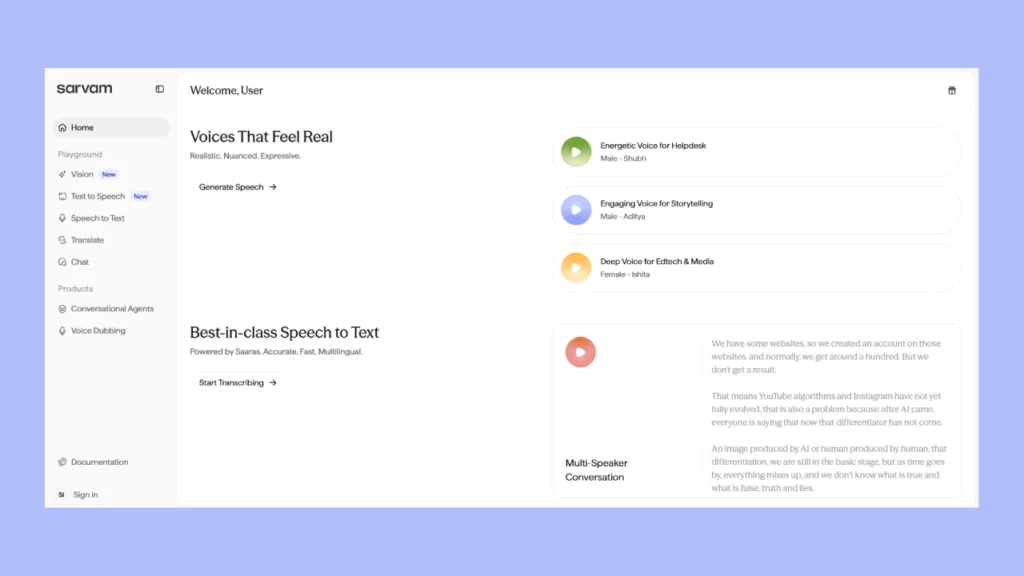
Sarvam’s current speech work already leans into multilingual Indian speech, and it also covers code-mixing, plus speaker diarization. Its Saaras V3 speech recognition system supports 22 Indian languages, as well as English, showing that the company is still investing heavily in speech AI for India-language-first scenarios.
Conclusion
Indic DiarBench tackles a big issue in speech AI research, specifically the absence of a more complete benchmark for checking both transcription and speaker attribution across India’s very diverse languages.
With roughly 108 hours of natural speech, coverage across all 22 scheduled Indian languages, real-world acoustic conditions, and human-verified speaker-attributed transcripts, this benchmark could become a crucial base for building better Indian-language voice technologies.
Since AI is gradually moving from text interfaces to voice-style interaction, benchmarks that mirror how people speak day-to-day, not only how they speak in neat, controlled recordings, will matter more and more. Indic DiarBench is a move toward making Indian speech AI more precise, more inclusive, and genuinely useful in real-life situations.
Disclaimer: This content has not been generated, created or edited by Finance SC. Publisher:
Source link
Source link