



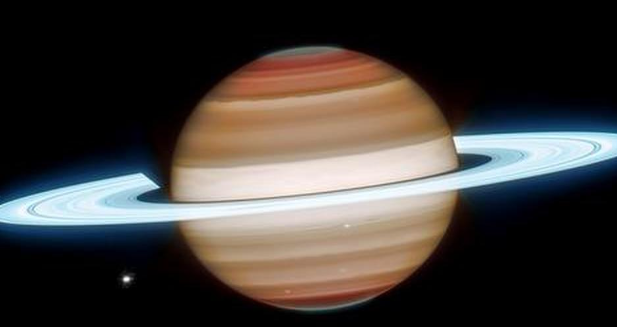
Context: NASA selected an innovative early-stage mission concept called PRAXIS for its NASA Innovative Advanced Concepts (NIAC) 2026 Phase I funding.

About The PRAXIS Mission:
What It Is?
- PRAXIS (acronym for Planetary Rings Autonomous EXploration with In-situ Sampling) is a futuristic spacecraft concept developed at NASA’s Jet Propulsion Laboratory (JPL) under the leadership of Dr. B. Marco Quadrelli.
- It integrates bio-inspired robotics, real-time artificial intelligence, and lightweight sampling mechanisms to interact directly with planetary rings.
Aim: To answer fundamental, high-priority questions identified by the Planetary Science Decadal Survey, including how planetary rings originate, how they dynamically evolve, and what ring particles (from millimeter- to centimeter-scale) are composed of.
Mission Timeline & Status:
- Phase I (Current – 2026): Received NIAC Phase I funding to conduct feasibility studies, numerical simulations, and system design evaluations.
- Phase II (Future Potential): If approved for Phase II advancement, the development team will proceed to construct and test a physical prototype.
- Operational Horizon: As a concept-stage study, actual flight mission implementation is targeted for future deep-space planetary exploration timelines.
Key Features of the Mission:
- Non-Destructive Ring Grazing Flight Path: Rather than flying through hazardous ring structures—which would risk destruction from high-velocity debris—the spacecraft hovers safely outside the ring plane.
- Touch-and-Go Deployable Boom Sampling: Uses a long, flexible, deployable robotic boom to extend into the ring plane, perform quick surface taps on target particles, snag free-floating material, and retract safely.
- Autonomous AI-Driven Operations: Driven by an onboard artificial intelligence model that autonomously selects candidate particles, handles real-time collision avoidance, and navigates inter-ring gaps without waiting for Earth-bound radio instructions.
- Millimeter to Centimeter Scale Focus: Designed specifically to collect and analyze particles larger than dust grains but smaller than house-sized boulders, bridging a vital gap in planetary observations.
- Onboard In-Situ Instrumentation: Equipped with miniaturized instruments to measure particle size, internal porosity, and exact chemical composition directly in deep space.
Disclaimer: This content has not been generated, created or edited by Finance SC. Publisher:
Source link
Source link