



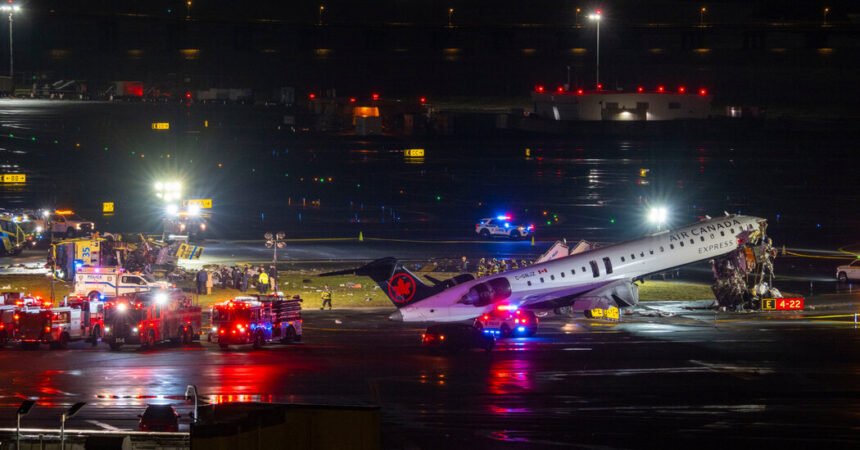
Two air traffic controllers stepped away early from their posts at LaGuardia Airport, potentially leaving the tower short-staffed before a jet collided with a fire truck in March, killing two people, according to two people familiar with the matter.
Those controllers are now among a dozen nationwide that the Federal Aviation Administration is taking steps to fire, the people said, as the agency investigates a wide range of timecard irregularities at air traffic control facilities across the country. Early departures that are not recorded as such, called “shoves,” are considered a form of timecard fraud.
The Wall Street Journal first reported Thursday that the agency was pursuing disciplinary action against the LaGuardia controllers. But the revelation that the F.A.A. is cracking down on the practice at a variety of air traffic facilities raises questions about whether already short-staffed towers are operating with fewer workers than official statistics suggest.
The F.A.A.’s moves come as the National Transportation Safety Board continues to probe the March 22 accident. A spokesman for the N.T.S.B. declined to comment about whether the board had also uncovered evidence of timecard fraud, adding that investigators were still probing the collision between the Air Canada Express jet and a fire truck.
In response to a request for comment, the Department of Transportation provided a statement from Sean Duffy, the secretary of transportation, suggesting that a majority of controllers were accurately reporting their hours.
“But when a small percentage of individuals take advantage of the American taxpayer, unfairly add additional work to their fellow controllers, and impact the airspace — we have no choice but to act,” Mr. Duffy said. “We will not tolerate fraud, and we are taking appropriate action to hold folks accountable and prevent unlawful practices from disrupting the traveling public.”
According to the board’s preliminary findings, there were only two controllers in the tower at 11:37 p.m. on March 22, when a landing Air Canada jet careened into a fire truck that had been given clearance to cross the runway. But investigators noted early on in their probe that it was unclear if other controllers had been present elsewhere in the tower, raising questions about whether official records correctly reflected staffing levels that night.
It is common practice at midsize airports like LaGuardia for just two people to work a shift overnight, when runway traffic is usually light. But on the night of the accident, the airport tower was especially busy, because rain and thunderstorms had delayed several arrivals and departures throughout the day, pushing them to the overnight shift.
A review of flights in and out of LaGuardia compiled by the tracking website FlightRadar24 revealed that after 11 p.m., the rate of takeoffs and landings was roughly the same pace as what controllers had been handling throughout the evening.
A spokesman for the National Air Traffic Controllers Association did not answer specific questions on the staffing protocols or if the F.A.A. plans to discipline the controllers.
“NATCA is actively discussing these allegations with F.A.A. leadership,” an emailed statement reads. “We believe those discussions are the appropriate forum for addressing the matter.”
Caitlyn Freeman and Patrick McGeehan contributed reporting.
Disclaimer: This content has not been generated, created or edited by Finance SC. Publisher:
Source link
Source link