



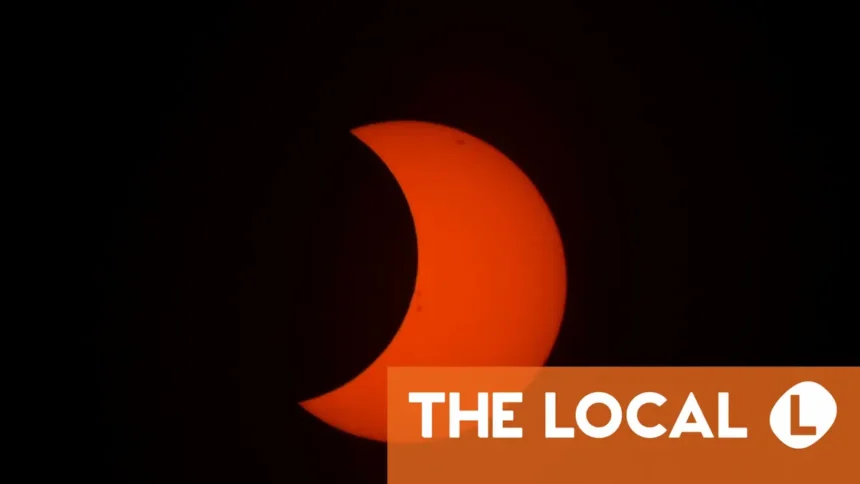
France will witness its first solar eclipse in 27 years on Wednesday, August 12th – here’s how to get the best view.
The eclipse will happen when the Moon passes between the sun and the Earth, blocking part of the Sun’s disk from view and casting its shadow on the ground.
Celestial happenstance has given our planet a satellite that is almost exactly the right distance and size from us to appear to be the same size as the star we orbit, which means that when the sun, moon and Earth are in the right alignment, the moon blocks out almost all of the sun.
We won’t quite get to see a total eclipse in France – totality will pass over the Arctic, Greenland, Iceland, the Atlantic, northern Spain and north-eastern Portugal – but the event will still be very impressive, with many still able to see more than 90 percent of the sun blocked by the moon.
When and where
The phenomenon will begin at around 7.20pm in France on Wednesday, August 12th and reach its peak around 8.20pm, when the sun will be low on the western horizon.
The sun will be more than 99 percent obscured in the Basque Country, around 92 percent in Paris, and around 90 percent in northeastern France.
Clear skies in that direction will be essential to fully enjoy the spectacle, hopefully by then smoke from the wildfires will have cleared.
This interactive map, from France’s Centre National d’études Spatiales (CNES), reveals the scale of the eclipse visible and various times from all parts of the country.
CNES also offers the following advice to observe a solar eclipse safely.
Safety advice
If possible, wear CE-certified eclipse glasses – ordinary sunglasses do not offer sufficient protection.
Similarly, binoculars, phones or cameras without solar filters amplify the danger.
In the absence of suitable protection, observation methods exist: projecting through a small opening: punch a small hole in aluminium foil or cardboard and project an image of the Sun on to a light surface on the ground.
Indirect vision: observe the shadows cast on the ground by natural “slits” – during a total eclipse, tree leaves, for example, cast small round images of the Sun.
The next total solar eclipse visible directly from France will be September 3rd, 2081. But, an annular eclipse – the one with the famous ‘ring of fire’ beloved of photographers – will cross southern France and Spain on January 26th, 2028.
A partial lunar eclipse, meanwhile, takes place in the early hours of August 28th.
Disclaimer: This content has not been generated, created or edited by Finance SC. Publisher:
Source link
Source link