


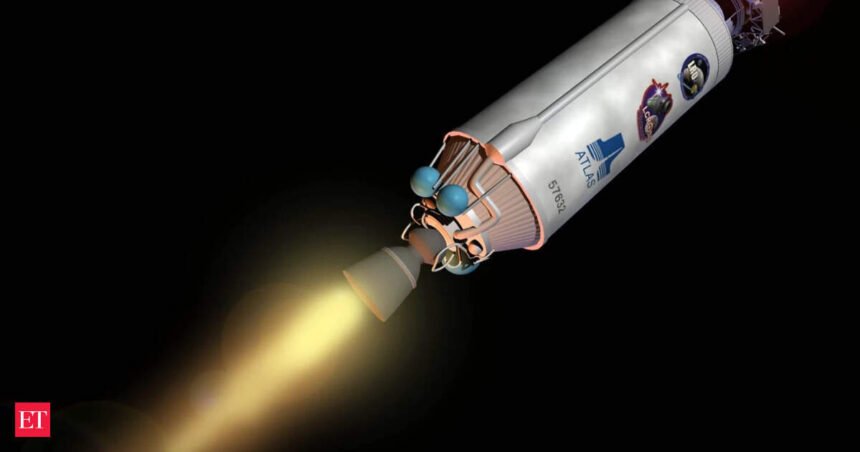

The LCROSS. Image credits: Wikimedia Commons
A 2010 article titled “Detection of Water in the LCROSS Ejecta Plume,” in the journal Science, by Colaprete et al., describes how this mission, the Lunar Crater Observation and Sensing Satellite, otherwise known as LCROSS, revealed the existence of a long-predicted presence of water ice on the lunar surface. Since the 1960s, scientists have predicted that some amount of frozen water must exist on the lunar surface. While that prediction was widely accepted, it had never been backed by strong evidence until LCROSS. It’s not exactly the most popular discovery made in 2009, given when it happened amid the cultural chaos of that year, but it has become one of the more consequential discoveries in the field of space exploration in recent years.
So what actually happened on October 9, 2009
LCROSS was launched in June 2009 together with the Lunar Reconnaissance Orbiter, using a Centaur upper stage that would later be used for the impact. Mission control commanded the used upper stage to impact into the area called Cabeus, a permanently shadowed crater in the vicinity of the lunar south pole, which is so cold that it might make Antarctica feel like a beach holiday. Four minutes later, the shepherding spacecraft through the ejecta, analyzed it using cameras, spectrometers, and radiometers, then impacted into the same crater.
The authors of the 2010 article, claims that the total amount of water vapor and ice found within the sensors’ range is about 155 kilograms, and the floor of the crater contains about 5.6 percent of water ice by mass. In other words, it is twice as humid as the sand in the Sahara Desert, as Space.com noted in their ten-year anniversary article.

What we learnt about the moon
The Moon was long thought to be an old, dull and largely dry rock, but LCROSS changed that view. In addition to water vapor, the plume contained some molecules of hydrocarbons, sulfur materials, and carbon dioxide. This reveals that these dark craters have preserved the material deposited in them during comet and asteroid impacts for many years because of the cold environment inside them. The moon can no longer be considered just as an old object, but as a kind of time capsule and, more practically, as a potential gas station in space.Why this actually matters
It is not just ancient history. That is the reason why NASA’s Artemis program has decided to focus its efforts on the lunar south pole and not the more comfortable, sunny parts of the moon that the Apollo astronauts traveled to in the 60s and 70s. Water ice could be used to create hydrogen and oxygen, providing astronauts with water to drink, air to breathe, and rocket fuel, without the need for them to bring anything from Earth, where it would be extremely costly. Artemis II, the program’s first crewed flight, launched on April 1, 2026, and carried four astronauts on a roughly ten-day flyby of the Moon without landing. NASA has since restructured the plan for what comes next: Artemis III, rather than being the landing mission, is now set to test a commercial lunar lander in Earth orbit in 2027, with the first crewed landing at the south pole pushed to Artemis IV, targeted for no earlier than 2028. None of it would be possible without LCROSS’s discovery back in 2009.
The part nobody likes to admit
This is where it gets a little less inspiring. If lunar water really is that important for America to go back to the moon, one would think that the execution follows suit. But sometimes it doesn’t. NASA allocated $450 million to develop VIPER, a rover built like a golf cart designed to drill down at the south pole and map out where exactly that ice is.
Diagram showing the exploded view of LCROSS. Image credits: Wikimedia Commons
Unfortunately, NASA canceled VIPER after it was all constructed in July 2024 due to cost overruns and delays, according to an article by Scientific American. The cancellation wasn’t the end of the story, though: over a year later, in September 2025, NASA signed a new, separate $190 million contract with Blue Origin to fly the already-built VIPER hardware to the lunar south pole on its Blue Moon Mark 1 lander, targeting late 2027, contingent on Blue Origin’s own lander first landing successfully. In other words, the original NASA-run VIPER project was genuinely canceled; what survived was the physical rover, later picked up under a completely new commercial contract. It’s a harsh lesson that there is a stark difference between finding water on the moon and using it. It’s much easier to be inspired by Artemis press releases than appropriations hearings.
What happens next
The fact of the matter is that we are just trying to catch up to what LCROSS showed us back in 2009. Subsequent missions, mapping from orbit, and other international missions are all striving to figure out how much ice is present down there and the feasibility of mining for it. As it stands, LCROSS is still our only benchmark in the meantime. It was bold, slightly crazy, pure brilliance, and it continues to inform decisions regarding the Moon to this day.
Disclaimer: This content has not been generated, created or edited by Finance SC. Publisher:
Source link
Source link