



Drop a small pellet of yttrium barium copper oxide into a shallow dish, pour liquid nitrogen over it until the boiling settles into a quiet simmer, and lower a rare-earth magnet toward its surface. The magnet stops in mid-air. It hangs there, sometimes tilted at an improbable angle, and if the ceramic is kept cold it will keep hanging — for hours, for days, for as long as the nitrogen holds out. The effect is not a trick of balance. The pellet is expelling the magnet’s field from its interior and, because of tiny imperfections in the ceramic, locking it into place. This is the Meissner effect combined with flux pinning, and it is what a superconductor looks like when it works.
The compound doing the levitating is YBa₂Cu₃O₇, usually written YBCO and pronounced “ib-co” by the people who grow it. Its transition temperature — the point at which electrical resistance collapses to zero — is around 93 kelvin, or roughly −180 °C. That number does not sound generous, but it is the number that changed everything. Liquid nitrogen boils at 77 kelvin. For the first time, a superconductor could be operated in a coolant that costs less per litre than milk.
Seventy-five years stuck below 30 kelvin
Superconductivity had been discovered in 1911, when Heike Kamerlingh Onnes cooled mercury in liquid helium and watched its resistance vanish. For most of the twentieth century that was where the field stayed: deep in the helium regime, a few degrees above absolute zero, in metals and simple alloys. The theoretical framework built by John Bardeen, Leon Cooper and Robert Schrieffer in 1957 — BCS theory — explained superconductivity as pairs of electrons coupling through lattice vibrations, and it seemed to imply a ceiling. Most estimates put the maximum plausible transition temperature somewhere around 30 to 40 kelvin. By the mid-1980s the record, held by a niobium germanium film, was 23 K. Progress had effectively stopped.
In January 1986, at IBM’s Zurich Research Laboratory, Georg Bednorz and K. Alex Müller were quietly working on the wrong sort of material. Müller had become interested in oxides — ceramic compounds usually regarded as insulators, not conductors. The pair began synthesising samples of a barium-doped lanthanum copper oxide and testing their resistance as they cooled. In a paper titled, cautiously, “Possible High Tc Superconductivity in the Ba−La−Cu−O System”, they reported a resistance drop starting near 35 kelvin. The word “possible” reflected genuine uncertainty: an ordinary metal-to-insulator transition can also look like a resistance drop, and the field was full of false claims that had not survived scrutiny.
This one survived. Within months, groups in Tokyo, Beijing and Houston had reproduced and improved the result. In early 1987, Paul Chu’s team at Houston and Maw-Kuen Wu’s at Alabama substituted yttrium for lanthanum and reported a transition at 93 K. YBCO had been made. Bednorz and Müller received the Nobel Prize in Physics that October — barely eighteen months after their original paper, one of the fastest awards in the prize’s history.
Why 77 kelvin matters more than the number suggests
The gap between 30 K and 93 K sounds like a modest engineering improvement. In practice it is the difference between a laboratory curiosity and something a hospital can afford to run. Liquid helium is expensive, scarce, and slippery in more than one sense: it evaporates through joints, requires elaborate cryostats, and depends on a global supply chain tied to natural-gas extraction. Liquid nitrogen is produced by the tonne from ordinary air, costs a few cents per litre in bulk, and can be poured from an open Dewar without dramatic loss.
Anything that superconducts above 77 K can, in principle, be cooled by simply keeping it wet with nitrogen. That opens the door to power cables that lose no energy over long distances, magnets strong enough to levitate trains, and sensitive detectors — the SQUIDs used in brain imaging and geophysical surveys — running without a helium refill every few weeks.
What the ceramic actually is
YBCO is not what most physicists in 1985 would have guessed a high-temperature superconductor should look like. It is brittle, black, and belongs to a family called the cuprates — layered structures built from sheets of copper and oxygen sandwiched between planes of heavier atoms. The superconductivity lives almost entirely in the copper-oxide planes. Change the oxygen content by even a few percent and the effect vanishes; a well-made sample of YBCO has a formula closer to YBa₂Cu₃O₆.₉ than the ideal seven, and the missing oxygen matters enormously.
What no one has fully explained, nearly forty years later, is why the cuprates superconduct at all. The BCS mechanism — electrons paired by lattice vibrations — does not fit the numbers. Something else is pairing the electrons in the copper-oxide planes, and identifying that something is one of the longest-running open problems in condensed matter physics. Candidates involve magnetic fluctuations, exotic states of the electron fluid, and effects that couple charge and spin in ways ordinary metals never do. The empirical rules for making a better cuprate are largely still empirical.
The levitation, more precisely
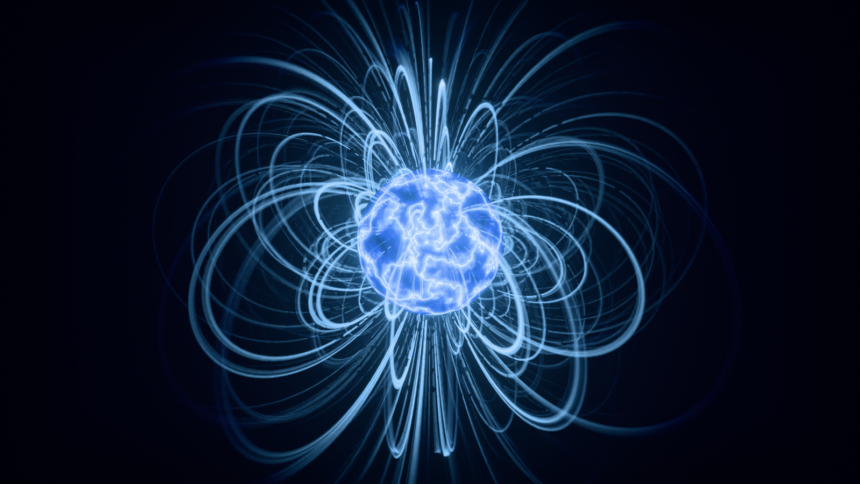
The demonstration that convinced most physics undergraduates that superconductors were real — the magnet floating over the cold pellet — combines two distinct effects. The Meissner effect, described in 1933, is the active expulsion of magnetic field from the interior of a superconductor: currents flow on the surface to cancel any field that tries to penetrate, and the material behaves as a perfect diamagnet. On its own, this produces repulsion but not stable levitation; the magnet would slide off.
Stability comes from flux pinning. YBCO is a type-II superconductor, which means that above a certain field strength it lets magnetic flux thread through it in narrow tubes called vortices. Defects in the ceramic — grain boundaries, impurities, oxygen vacancies — anchor these vortices in place. Once the magnet is positioned and the pellet cooled through its transition, the vortex pattern is frozen in. Move the magnet, and the pinned flux tubes drag it back. Tilt the pellet, and the magnet tilts with it. The magnet is not floating on a cushion; it is locked to a field configuration inside the ceramic.
A current started in a well-formed superconducting loop will keep circulating essentially forever — persistent-current experiments have run for years without measurable decay. In the sense that matters most to an engineer, the resistance is not merely low. It is zero.
What came after 93 K, and what didn’t
The cuprates kept climbing. Mercury-based compounds reached about 133 K at ambient pressure, and higher still when squeezed. In the last decade, hydrogen-rich compounds under enormous pressures — lanthanum hydride at 170 gigapascals — have shown signs of superconductivity above 250 K, tantalisingly close to room temperature but useless outside a diamond anvil cell. Claims of ambient-pressure room-temperature superconductivity, including the LK-99 episode in 2023, have so far not survived replication.
YBCO itself, meanwhile, has gone quietly industrial. It is drawn into coated conductor tapes used in experimental power cables in Chicago and, earlier, on Long Island, in the magnets of compact fusion reactors being built by Commonwealth Fusion Systems and Tokamak Energy, and in the coils of high-field research magnets that would be impossible with older materials. A ceramic that shatters if dropped now carries thousands of amps in machines meant to run for decades.
The pellet in the dish, with its stubbornly floating magnet, remains the clearest demonstration of what the 1986 discovery unlocked. Nothing is holding the magnet up. Nothing is pushing it down. It simply hovers, in a state of matter that was not supposed to exist above 30 kelvin, cooled by a liquid poured out of a thermos.
Disclaimer: This content has not been generated, created or edited by Finance SC. Publisher:
Source link
Source link