


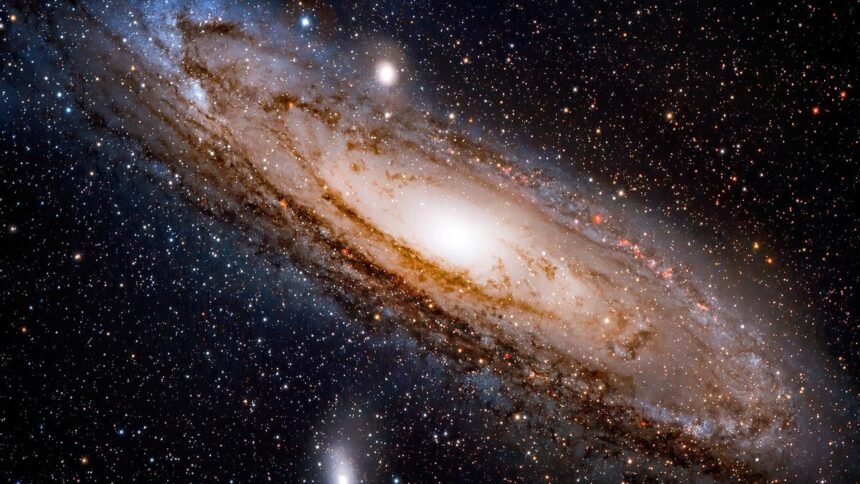

A true-colour photo of the Andromeda Galaxy. M32 is visible above and slightly to the left.
| Photo Credit: David Dayag (CC BY-SA)
Astronomers have used data collected by the Hubble Space Telescope to piece together the clearest yet map of star formation across most of the Andromeda Galaxy over the last 500 million years. The Andromeda is 2-2.5-times wider than the Milky Way, and the two galaxies have a coin-toss’s chance of colliding within the next 10 billion years.
Using their map, the astronomers found that the Andromeda’s star formation rate has been steadily dropping, especially over the last 40 million years. Recent star formation was concentrated in the Galaxy’s ring structures, and that is where the rate is declining most as well.
They also found a ‘dead zone’ near M32, a small satellite galaxy of the Andromeda. Specifically, in the part of Andromeda closest to M32, they found new stars had almost completely stopped forming — an indication that M32 had likely crashed through or interacted with Andromeda’s disc of stars (stellar disc) recently, disrupting the gas clouds from which new stars are born.
The team interpreted their data to mean the Andromeda Galaxy is currently transitioning to its ‘middle age’, away from being a vibrant, active galaxy and towards a quiescent state akin to retirement. The researchers also said that astronomers need better ways to measure distant galaxies: if a galaxy’s activity is changing fast, their usual tools could be revealing a false picture of its health. Thus, they concluded, understanding Andromeda can point the way to better understanding the lives of massive galaxies.
The findings were published in The Astrophysical Journal on July 27.
Published – July 28, 2026 03:53 pm IST
Disclaimer: This content has not been generated, created or edited by Finance SC. Publisher:
Source link
Source link