



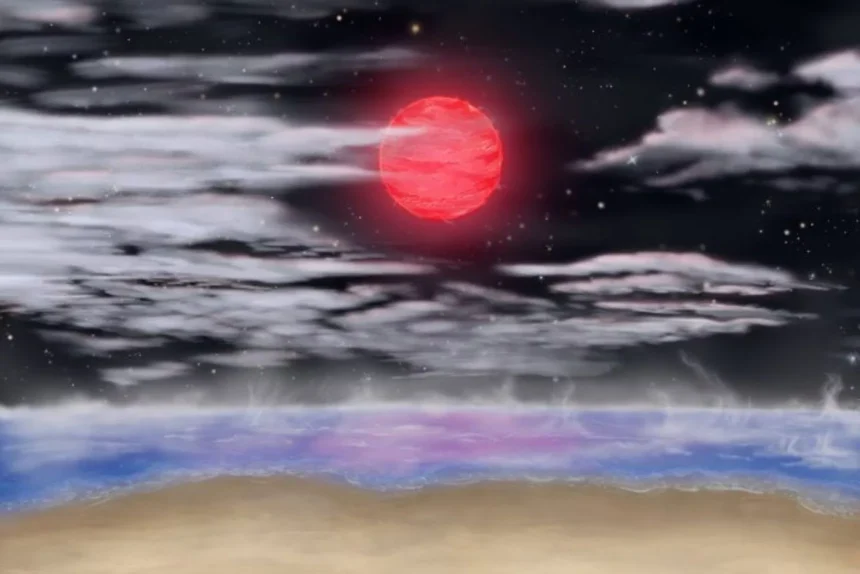
Just outside our galaxy, in fact, 25 light-years away to be precise, is a small red dwarf star named GJ 3378. Classified as an M4V star, it is fully convective, a type of star that churns its gases from core to surface like a cosmic cauldron. For astronomers, such stars are fascinating targets in the search for planets, especially with instruments designed to detect subtle stellar wobbles caused by orbiting worlds.
That anticipation was recently fueled by the announcement of a potentially habitable planet, GJ 3378 b, orbiting this star, by a team led by astronomers at the University of California, Irvine. That data, taken with the SPIRou spectrometer, implied a planet that orbits once every 24.73±0.06 days.
Also, it is roughly twice the size of Earth and sits inside its star’s ‘Goldilocks’ region. This super-Earth receives about 90% as much radiation from its star as Earth does from the Sun, putting it right in the ideal zone.
Paul Robertson, UC Irvine associate professor of astronomy and lead author of the new study, said, “This one’s exciting. It’s one of our closest cosmic neighbors. 25 light-years sounds like a long way, but the Milky Way is about 100,000 light-years across, so in that respect it’s our next-door neighbor.”
Astronomers made this discovery using the Habitable-zone Planet Finder on the Hobby-Eberly Telescope at McDonald Observatory in Texas, and the NEID Spectrometer on the WIYN Telescope at Kitt Peak National Observatory in Arizona.
Researchers at the University of Pennsylvania and the University of Texas had been monitoring GJ 3378 with the Habitable-zone Planet Finder (HPF) spectrometer on the Hobby–Eberly Telescope at McDonald Observatory. They also obtained data at the NEID spectrometer based on Kitt Peak National Observatory during their research. Returning to SEDM, a spectrograph installed on Mt. For comprehensive details of the planet’s orbit, the measurements were then combined with those from SPIRou and the CARMENES spectrometer in Spain.
What they found was striking: the orbital model differed significantly from the earlier solution. Their joint analysis shortened the planet’s year to 21.45 ± 0.01 days and reduced its minimum mass.
Despite the shorter orbit, the planet remains within the star’s conservative liquid-water habitable zone, the region where conditions might allow water to exist on the surface. The reduced mass, meanwhile, increases the likelihood that GJ 3378 b is a rocky, terrestrial planet rather than a gaseous mini-Neptune.
Those conditions together put the planet at what researchers refer to as a “cosmic shoreline.” But it’s a tenuous boundary, with planets around M dwarfs also at risk of having their atmospheres stripped away by the searing radiation of their stars. It is not yet clear if GJ 3378 b retains its atmosphere or has been completely stripped of it.
Robertson said, “If you scale the Earth down to the size of an apple, its atmosphere would be about as thick as the skin of the apple. That’s just enough to maintain the surface pressures at which you can have liquid water. It’s enough that there’ll be breathable air, and it provides maybe a little bit of protection from the harsh radiation environment of space.”
Taken together, these factors put the planet close to what scientists call a “cosmic shoreline.” It is a delicate balance, where planets in orbit around M dwarfs face the danger of being stripped of their atmospheres by the continuous bombardment from their stars. It is unclear if GJ 3378 b is capable of holding on to its atmosphere or has had its atmosphere blown away.
For GJ 3378 b, the revised properties make it an especially intriguing candidate. A rocky planet in the habitable zone of a nearby star is exactly the kind of world astronomers hope to study in detail with future telescopes.
Gogod James, a UC Irvine student in Robertson’s group who worked to characterize the size of GJ 3378b, said, “If a planet in the habitable zone has a proper atmosphere, we can justify further research looking for biosignatures, liquid water, or other signs of life that require both an atmosphere and the right amount of heating from the host star.”
GJ 3378 b may serve as a reminder to astronomers that the hunt for life off of Earth is just as much about perseverance as it is about finding success. New datasets add subtlety, occasionally reversing earlier conclusions and, we hope, nudging us closer to a complete accounting of the worlds that inhabit our galaxy.
For now, GJ 3378 b is a reminder that there are surprises even in our own cosmic backyard, and the line between habitability and desolation may be thinner than we thought.
Journal Reference:
- Paul Robertson, Michael Endl, William D. Cochran, Gudmundur Stefansson et al. A Revised Mass and Period for the Habitable Zone super-Earth GJ 3378 b: A Planet Straddling the Cosmic Shoreline. The Astrophysical Journal. DOI 10.3847/1538-4357/ae732b
Disclaimer: This content has not been generated, created or edited by Finance SC. Publisher:
Source link
Source link