


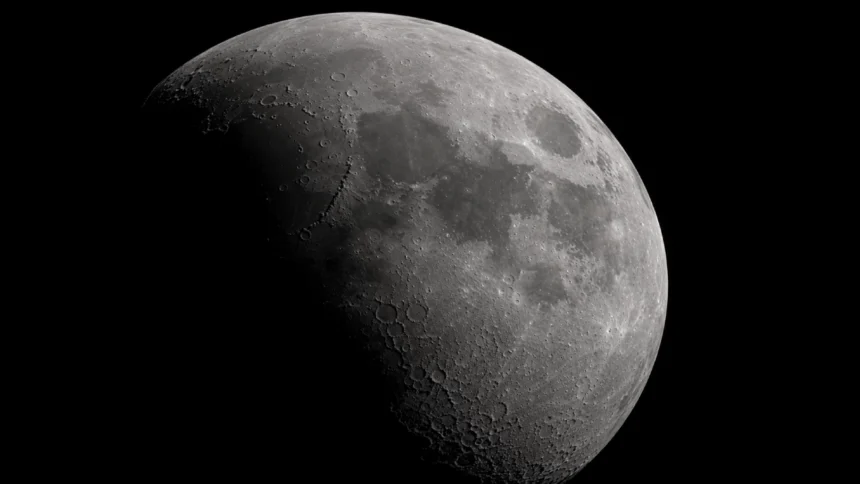
When we picture the Moon, we usually imagine a barren, lifeless world. Its surface is blasted by ultraviolet radiation, extreme temperatures, and cosmic rays, conditions that make survival nearly impossible for most organisms.
Past crewed missions all explored equatorial regions, where these harsh factors are especially intense. But a new study published in Science Advances suggests that the Moon’s poles, particularly the South Pole, may harbor tiny pockets where Earth microbes could cling to life.
The Moon’s own rotation axis is slightly tilted. It keeps the Sun permanently low in the sky over the lunar north and south poles, never rising high above the horizon. Low-angle sunlight sweeps across the ground at the Moon’s north and south poles, casting long shadows from all the undulating, cratered terrain.
Each of these regions is gradually brought into a state where it remains in permanent shadow and is therefore never subjected to sunlight. In these sunless areas, temperatures are extremely low: cold, dark, and still, yet they can trap the water ice hidden within them, preventing it from vaporizing into gas.
They also block the lethal radiation that would directly kill living organisms, keeping those deadly rays outside the shadow. Researchers currently mapping these shadowed regions have discovered that these conditions allow several specific types of microorganisms to survive for at least one day.
Even so, these microorganisms can only barely cling to life; they cannot grow and reproduce there, let alone thrive and multiply.
Even with strict sterilization procedures, some organisms are remarkably stubborn. One example is Aspergillus niger, a fungus familiar to anyone who’s seen black mold in a bathroom. It has been found inside the International Space Station and, astonishingly, has survived outside it as well.
This resilience made it one of five microbes chosen for the study, alongside bacteria such as Bacillus subtilis, Staphylococcus aureus, and the famously radiation-resistant Deinococcus radiodurans, plus several Fusarium species.
Aaron Regberg, a geomicrobiologist at NASA’s Johnson Space Center, noted that these species aren’t even considered “extremophiles,” organisms specialized for extreme environments. Their ability to endure space conditions was unexpected.
The team ran simulations at three sites at the South Pole: the Nobile Rim, the Connecting Ridge, and the De Gerlache Rim. By using environmental maps prepared from data obtained by NASA’s Lunar Reconnaissance Orbiter, the team investigated the effects that radiation and temperature would have on microbial survival.
The results revealed ‘survivable niches’ ranging from crater floors miles wide to something as small as an astronaut’s boot print. Aspergillus niger proved especially hardy, surviving even in areas with partial sunlight thanks to its resistance to ultraviolet radiation. UV light is so deadly to most microbes that hospitals use it for sterilization, making this finding striking.
Prabal Saxena, the study’s lead author and a planetary scientist at NASA’s Goddard Space Flight Center, reflected on the dual nature of microbial stowaways: “Humans are natural explorers, and with them come their voices, their memories … and their microbes. For some scientists, myself included, that reality can be unsettling. But it also creates an opportunity to turn an imperfect situation into a useful experiment.”
Heather Graham, a co-author at NASA Goddard, added: “When we think of the Moon, we don’t typically think of biology. But the Moon is a place where a cell can survive, so our first exploration of these sites should pay extra attention to our microbial hitchhikers and work hard to characterize lunar chemistry before our visits change what we will find.”
The possibility that Earth microbes could survive, at least for a short period, at the Moon’s South Pole raises many important questions. It might accidentally introduce terrestrial life into the lunar environment, making it more difficult to study the original lunar chemistry. At the same time, such hardy organisms could serve as natural experiments and help scientists understand how life responds to extreme conditions.
Journal Reference:
- Prabal Saxena, Stefano Bertone et al. Potential survivable niches for microbial life on the lunar south pole. Science Advances. DOI: 10.1126/sciadv.aec0811
Disclaimer: This content has not been generated, created or edited by Finance SC. Publisher:
Source link
Source link