



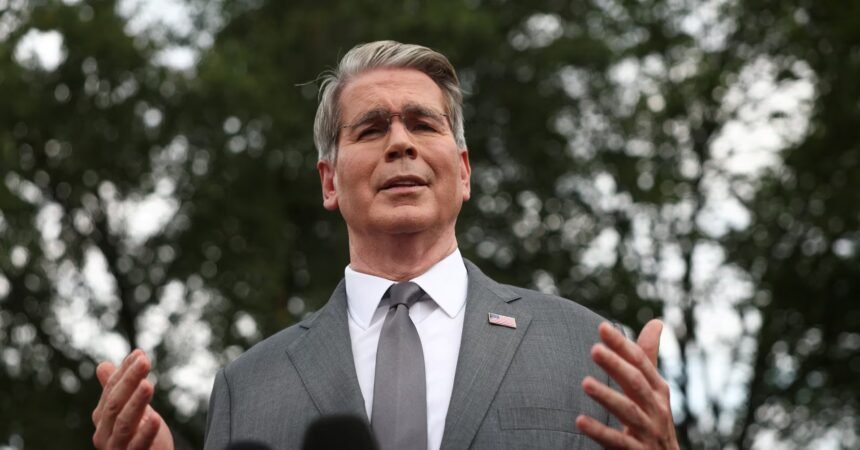
Bessent said he would hold a press conference on Monday to discuss details.
Sign up here.
“It is a one-two punch. We have the blockade (on Iran), and we are going to have the toughest sanctions in history,” Bessent told CNBC. “It is going to work in Iran and we are going to collapse this regime.”
“Regarding the Iran issue, sanctions and pressure do not help resolve the problem. China calls on the relevant parties to take responsible actions and resolve the issue through political and diplomatic means,” a spokesperson for China’s embassy in Washington said in response to Bessent’s comments.
China buys more than 80% of Iran’s shipped oil, according to 2025 data from analytics firm Kpler. If the U.S. engaged in further economic warfare with China, a major exporter to the U.S., including vital rare-earth minerals, it would risk retaliation.
Iran has weathered punishing economic sanctions for nearly 50 years, since the Islamic Revolution of 1979. Iranian Foreign Minister Abbas Araqchi called Trump’s comments an attempt to divert American public opinion from domestic financial problems, including record debt and rising interest rates.
“We have asymmetric information, and I’m not sure why oil has popped up on this,” Bessent said. “If we are doing the maximum economic pressure, then that means that likely there will not be a large-scale kinetic restart.”
When asked if the U.S. could target China for doing business with Iran, Bessent said many conversations were best to have in private.
“We are confident that everyone wants the Strait (of Hormuz) reopened, and for energy prices to come back down,” he said. “Keep in mind that the Chinese get 50% (of their) energy from inside the Gulf. So it would do them a big service to get with the program.”
Reporting by Susan Heavey, Michelle Nichols and Kanishka Singh; writing by Michelle Nichols and Kanishka Singh; editing by David Ljunggren, Rod Nickel and Chris Reese
Our Standards: The Thomson Reuters Trust Principles.
Disclaimer: This content has not been generated, created or edited by Finance SC. Publisher:
Source link
Source link