



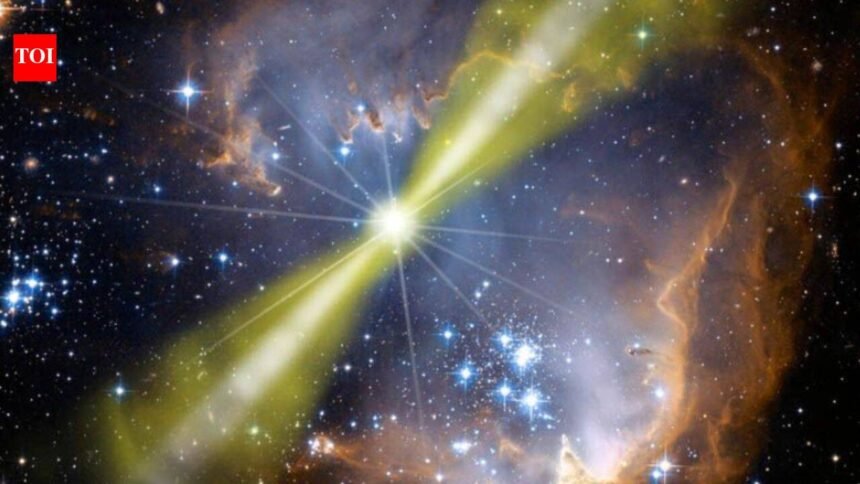
For more than half a century, gamma-ray bursts have remained one of the most puzzling events observed in space. These bursts are sudden flashes of gamma rays, a very high-energy form of light. They can appear from almost any direction in the sky and can last from less than a second to several minutes.The discovery of the gamma rays happened very unexpectedly. According to NASA, in July 1967, US satellites called Vela 3 and Vela 4 were watching for signs of nuclear weapons tests that could violate the Nuclear Test Ban Treaty. Instead, the satellites detected brief flashes of high-energy photons or gamma rays coming from space.At first, scientists did not know what they were seeing. Some thought the bursts might be coming from somewhere relatively close to Earth, perhaps within the Solar System or the Milky Way. Others believed they could be coming from much farther away. But they could not immediately connect the bursts to any known stars or galaxies.The mystery continued for years because the bursts disappeared almost as quickly as they appeared. Once a burst faded, there was no obvious object left behind that could be studied.
An accidental discovery
The Vela satellites were built for a very different purpose. They carried detectors designed to identify X-rays, gamma rays and neutrons that could indicate a nuclear explosion. The first gamma-ray burst was detected on July 2, 1967, but scientists did not determine what the signal represented until much later.Los Alamos scientists studied a number of similar events recorded by the Vela satellites. In 1973, they published their findings on 16 bursts observed between July 1969 and July 1972. Their conclusion was that the gamma-ray bursts were of cosmic origin.Other spacecraft soon added to the evidence. The Soviet Konus satellites published data in 1974 that confirmed the detection of these gamma-ray bursts.In 1976, scientists began the Interplanetary Network, or IPN, which used gamma-ray detectors on spacecraft studying the Sun and planets. The detectors worked together to locate bursts through a process called triangulation. By narrowing the positions of the bursts to a few arc minutes, scientists found that the sources did not match known X-ray emitters or other familiar sources. Even then, the origin of the bursts remained uncertain.
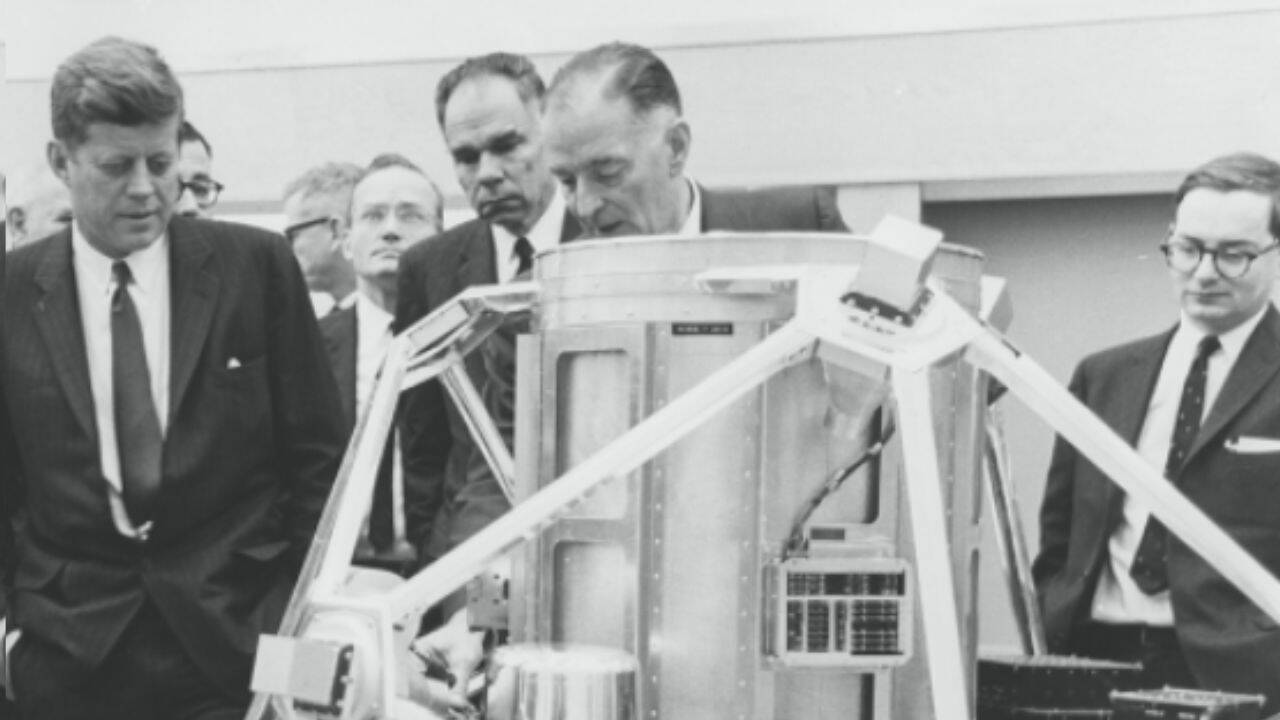
President John F Kennedy learning about Vela in 1962 (Sandia National lab photo)
A major breakthrough
A major change came with NASA’s Compton Gamma Ray Observatory, launched in 1991. One of its instruments, the Burst and Transient Source Experiment, or BATSE, was built to study gamma-ray bursts.BATSE detected more than 2,700 bursts during its nine years of operation. Its observations showed that the bursts were spread uniformly across the sky rather than being concentrated along the plane of the Milky Way.This was an important clue. If the bursts were coming from objects inside our galaxy, scientists would have expected their distribution to follow the Milky Way more closely. Instead, the observations showed that gamma-ray bursts were coming from far outside the galaxy.That created a new problem. If the bursts were billions of light-years away and could still be detected, the events producing them had to release an enormous amount of energy.In 1997, the Italian-Dutch BeppoSAX satellite helped take the next major step. It detected an X-ray afterglow associated with a gamma-ray burst. This gave astronomers a way to study what happened after the initial flash and helped establish that gamma-ray bursts were extragalactic, with some coming from many billions of light-years away.Astronomy observations later showed that these events could release an amount of energy comparable to that of a supernova in seconds. Their peak luminosities can be 100 billion billion times that of the Sun and a billion times greater than even the brightest supernovas.
Search continued
The discovery of X-ray afterglows in the late 1990s opened a new period of gamma-ray burst research. Observations of some bursts also found elements such as iron, silicon, sulfur and argon around the events. These elements are associated with supernovas and helped strengthen the link between some gamma-ray bursts and the deaths of massive stars.In 1999, the afterglow of GRB990123 was detected within seconds of the original burst. Scientists studying it concluded that the energy was channelled into narrow jets and that gamma-ray bursts can be detected when one of those jets is aimed towards us.The same period also brought evidence connecting some bursts with supernovas. Observations of GRB990705 showed an iron-absorption feature in its afterglow that was characteristic of a supernova. Later observations of GRB991216 found iron lines in its afterglow as well.By 2003, NASA had announced strong evidence that long-duration gamma-ray bursts were formed by the deaths of massive stars and the simultaneous creation of black holes.
Seeing gamma rays from Earth
Gamma rays cannot reach Earth’s surface directly because they are blocked by the atmosphere. Scientists can, however, study very-high-energy radiation from some gamma-ray bursts using ground-based observatories, Quanta magazine writes.Gamma rays interact with particles in Earth’s atmosphere. These interactions can produce particles moving faster than the speed of light in air. They then produce a blue glow known as Cherenkov radiation. Scientists can detect this glow and use it to study very high-energy gamma rays.This approach has an advantage. Earth’s atmosphere provides a much larger collecting area than a single telescope, giving scientists a better chance of detecting rare, very high-energy gamma-ray bursts.The first observation of an ultrahigh-energy gamma-ray burst using this method came in July 2018. The High Energy Stereoscopic System, or HESS, in Namibia detected radiation from the afterglow of a gamma-ray burst.The radiation was not from the initial burst itself. Instead, the jet from the burst had collided with material thrown out by the star during the supernova. The collision accelerated particles to very high speeds, producing electromagnetic radiation that eventually reached Earth.
A longer-lasting afterglow
Scientists later observed an even longer high-energy afterglow from GRB 190829A. The burst was about 1 billion light-years away, relatively close compared with some other gamma-ray bursts. HESS studied it for 56 hours and found that the higher-energy radiation continued for more than five times longer than the earlier result recorded in 2018.“This is basically a breakthrough result,” Brian Reville, a physicist at the Max Planck Institute for Nuclear Physics in Germany, told Quanta magazine. “To detect very-high-energy gamma-ray photons up to three nights after the explosion is just really something.”The observation has raised questions about the relatively simple models scientists use to explain how gamma-ray bursts are produced. It suggests that the physics involved may be more complicated than previously thought.
Disclaimer: This content has not been generated, created or edited by Finance SC. Publisher:
Source link
Source link