


A day after reports of an FIR registered in Noida against a woman named Ruchika Singh for “abusing” Prime Minister Narendra Modi came to light, a senior Delhi Police officer said on Friday that the case had been transferred to the Parliament Street police station for further investigation.
When reached for comment, Deputy Commissioner of Police (New Delhi) Sachin Sharma said the case had not yet been handed over to them as of Friday evening. “We will decide the course of action once we get it,” he said.
On Wednesday, the U.P. police registered a zero FIR, which allows a complaint to be filed at any police station regardless of the crime’s location, under Sections 352 (intentional insult to provoke breach of peace), 353(1) (statements conducive to public mischief), and 356(1) (defamation) of the Bharatiya Nyaya Sanhita at the Expressway police station, based on a complaint by a Ghaziabad resident, Smriti Singh.
The complainant alleged that Ms. Ruchika Singh, a Noida resident, used “abusive and objectionable” language against Mr. Modi, thereby undermining “the dignity of the constitutional office”. She claimed that the remarks were intended to “spread hatred and disrupt public peace”.
‘Misuse of machinery’
Reacting to the development, Cockroach Janta Party (CJP) spokesperson Saurav Das posted on X: “The misuse of criminal machinery against Ruchika Singh is unacceptable. Profanity does not attract a criminal case. The police can focus their energy elsewhere, not on a 25-year-old.”
In a video statement, CJP founder Abhijeet Dipke remarked, “Law should be the same for everyone. It cannot be used against the youth of the country and not against political leaders for using abusive language.”
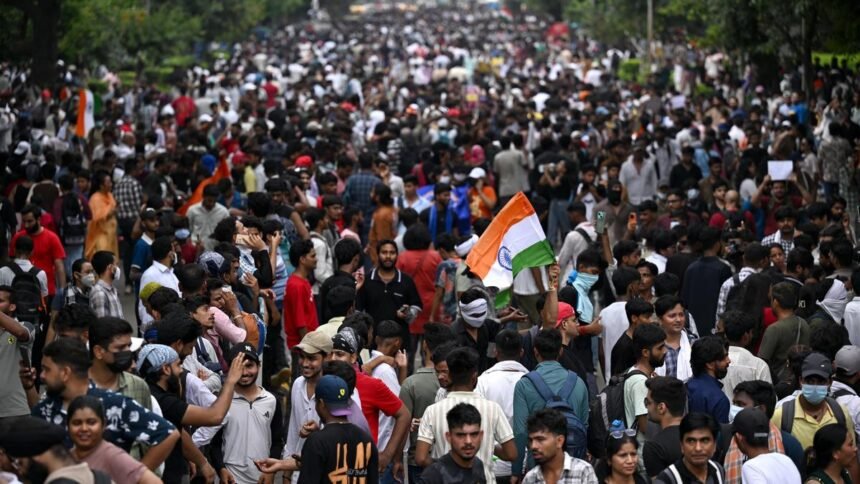
The FIR comes against the backdrop of the CJP-led protest at Jantar Mantar, which was called off on July 25 after Dharmendra Pradhan stepped down as the Union Education Minister.
Since then, media clips and social media content posted by women during the 36-day protest have been circulated on social media and they have been subjected to online harassment, with multiple instances of women being doxxed (publishing or circulating personal information) and threatened with rape and death.
Harassment continues
One such post on Friday by an X user identifying himself as Shashi Kumar, a co-convener of the Bharatiya Janata Party’s Uttar Pradesh social media unit, contained a video of three women and sought an FIR against them purportedly for similar “offences” as those Ms. Ruchika is accused of.
Similarly, an X handle ‘The Jaipur Dialogues’ shared a video of All India Students’ Association national president Neha, a prominent face in the Jantar Mantar stir who sat on a 23-day hunger strike, while calling on the Bajrang Dal to “teach her a lesson”.
The account has posted several photographs and videos of protesters since July 23, seeking their identification and demanding action against them.
Several anonymous accounts have also shared videos and photographs of protesters, alleging that they insulted the Prime Minister, the Army or attacked police personnel during the demonstration. Personal details, including phone numbers and addresses, have been circulated in some instances, while comments under the posts contain abusive and obscene remarks.
Fear of doxxing
A 19-year-old protester, whose video containing critical remarks against the Centre was made public, said she had deleted her social media accounts out of fear of doxxing and threats. “I have deleted all my accounts. The way phone numbers and addresses of women are being shared online is wrong. I have not said anything wrong, but neither have those girls. The trolls don’t care about that. If my video also goes viral, I might get called back home,” she said.
Digital rights expert Aparajita Bharti, a founding partner at TQH Consulting, said India’s laws do not specifically address doxxing despite its increasing use to target individuals online. “Doxxing has become a common method to harass people online, but our laws do not clearly define it or recognise its harms. It is legally in a grey area. When it is increasingly used to harm women, they simply withdraw from the online space,” she said.
Ms. Bharti added that obscene speech and illegal speech are often conflated. “You can find something offensive, but it is not necessarily illegal. If people are issuing sexual threats, those are actionable. But sharing personal information is not specifically covered under Indian laws. Cyber cells can still ask platforms to take down such content, and that remains one of the available remedies, which all depends on the actionability.”
Published – July 31, 2026 03:47 pm IST
Disclaimer: This content has not been generated, created or edited by Finance SC. Publisher:
Source link
Source link