



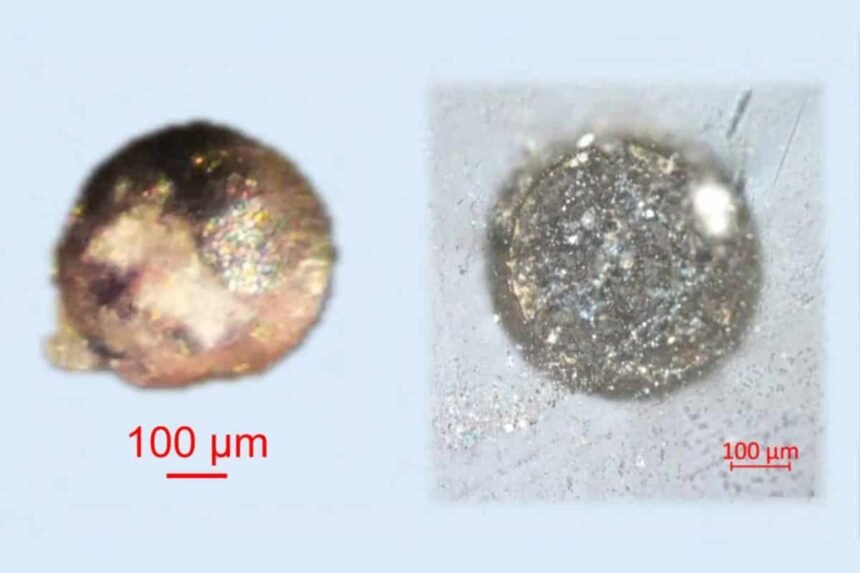

A grain of metal scarcely wider than a red blood cell has preserved an atomic arrangement born in the fireball over Hiroshima.
Scientists found the particle inside a glassy droplet recovered from beach sands in Hiroshima Bay. It contains a previously unknown, silicon-rich alloy made from iron, chromium, nickel, manganese, molybdenum, silicon and aluminum — elements that most likely came from buildings and other urban materials vaporized when the atomic bomb exploded on that fateful day, August 6, 1945.
The discovery, reported in Science Advances, adds a new and unsettling chapter to the study of atomic-blast debris. For a few seconds, the huge atomic blast mixed familiar substances at extreme temperatures and then cooled them so quickly that atoms became locked into a complex, orderly structure not previously documented in an alloy anywhere on Earth.
How An Entire City Turned into Microscopic Droplets

The Hiroshima bomb detonated as an airburst roughly 600 meters above the city with a yield of about 15 kilotons. Its fireball exceeded 7,000 degrees Celsius, engulfing air along with vaporized steel, aluminum, glass, soil and water. As the fireball expanded, some of that vapor condensed into droplets that cooled in flight and eventually settled around Hiroshima Bay.
Researchers call these particles “hiroshimaites.” A 2019 study in Anthropocene first described the strange fallout in beach sands, including glass spheres, filaments and fused particles. Their mineral makeup indicated that some had formed above 1,800 degrees Celsius.
For the new study, Luca Bindi, a crystallographer at the University of Florence in Italy, and his colleagues examined 34 hiroshimaites. One glassy spherule contained many flecks of metal, making up only about one to three percent of the object. The team selected four grains, each roughly 10 micrometers across, and removed them by hand with fine needles.
Three proved to be relatively ordinary iron-chromium alloys. The fourth did not.
Chemical mapping showed that iron dominated the grain’s composition, but substantial amounts of chromium, silicon and nickel were mixed with manganese, molybdenum and aluminum.
An Orderly Structure Created in Chaos

Knowing which elements were present was only the first step. The researchers then used single-crystal X-ray diffraction, which reveals how atoms are arranged by measuring the pattern produced when X-rays scatter through a crystal.
The result showed a cubic structure known as the AlAu4 type, an ordered relative of the beta-manganese structure. The architecture itself was not unknown, but no one had reported this particular iron-rich, silicon-rich mixture adopting it. Alloys with similar ingredients would normally settle into simpler arrangements common in stainless-steel-like materials.
The surprise lies in the combination. Many modern multicomponent alloys gain their properties from several elements sharing positions in a relatively disordered atomic lattice. This grain contains a similarly crowded chemical mixture, yet its atoms occupy a highly organized framework. The authors describe it as a possible bridge between complex alloys and ordered compounds, rather than a conventional “high-entropy alloy.”

How could an explosion create something new from ordinary city materials? The elements themselves are common, but it’s their arrangement that’s novel. The researchers propose that metals from several sources vaporized, mixed in the fireball, condensed into a tiny molten droplet and then froze almost instantly. Rapid cooling prevented the atoms from rearranging into the simpler structures they would normally favor.
Atomic Debris Is Revealing a Pattern

The newly identified and surprising alloy extends a series of discoveries showing that the residue of nuclear explosions can form exotic materials during seconds of extreme heat, pressure and rapid cooling.
A 2024 study in Earth and Planetary Science Letters used silicon and oxygen isotopes to show that Hiroshima glasses condensed from a mixture of air, water and vaporized city materials. Its models placed much of that condensation within roughly 1.7 to 5.5 seconds as the cloud cooled from about 3,200 to 1,000 kelvins. The researchers even compared the glasses with some of the earliest mineral condensates in the solar system.

The Trinity nuclear test in New Mexico left a different material record. A 2021 Proceedings of the National Academy of Sciences paper identified a previously unknown quasicrystal in red trinitite, the glass produced when the blast fused desert sand with copper and other material from the test apparatus. In May 2026, another PNAS study reported a new calcium-copper-silicon clathrate — a cage-like crystal that scientists had never seen before — in the same debris. Both these studies were led by the same Luca Bindi, who is now one of the world’s foremost authorities on nuclear blast-derived materials.
The new findings add a lot more depth to what we know. Trinity detonated about 30 meters above the desert and coupled strongly with the ground. Hiroshima exploded much higher, reducing direct contact between the fireball and the surface. Each event therefore mixed different materials and followed a different path of heating, expansion and cooling, producing its own microscopic archive.
What The Hiroshima Grain Can and Cannot Tell Us
The researchers argue that such particles could aid nuclear forensics. Their chemical ingredients may point to the materials caught in a nuclear explosion, while their crystal structures can preserve clues about temperature, oxidation and cooling. A grain only a few micrometers wide can, in effect, record conditions that existed for seconds. You could use this information to identify undisclosed nuclear testing sites.
The alloy itself may also offer some practical ideas for materials science. Iron-chromium-nickel alloys underpin stainless steels and many corrosion-resistant materials. Reproducing a related ordered structure through rapid solidification, powder processing or additive manufacturing could reveal useful combinations of hardness, heat resistance, magnetism or other properties. You wouldn’t necessarily need detonating a nuclear blast to produce similar results, fortunately.
As a major caveat, the study’s discovery rests on a single tiny grain. The material is not yet a practical alloy or a recipe for manufacturing one.
The grain does not soften the history that made it. It does show that, more than 80 years later, Hiroshima’s debris still holds physical details of the seconds in which the city was destroyed.
Disclaimer: This content has not been generated, created or edited by Finance SC. Publisher:
Source link
Source link