


Thinkers have struggled for hundreds of years with a deceptively simple question: Is it better to have an organization under one, central strong leader, or do the best organizations emerge when individuals simply self-organize? Be it philosophizing in the garden of Plato about governance, or engaging people on boards today and navigating that tension between hierarchy versus collective decision-making.
Now, a new study published in PNAS suggests that honeybees may hold the answer, and it’s not what you might expect.
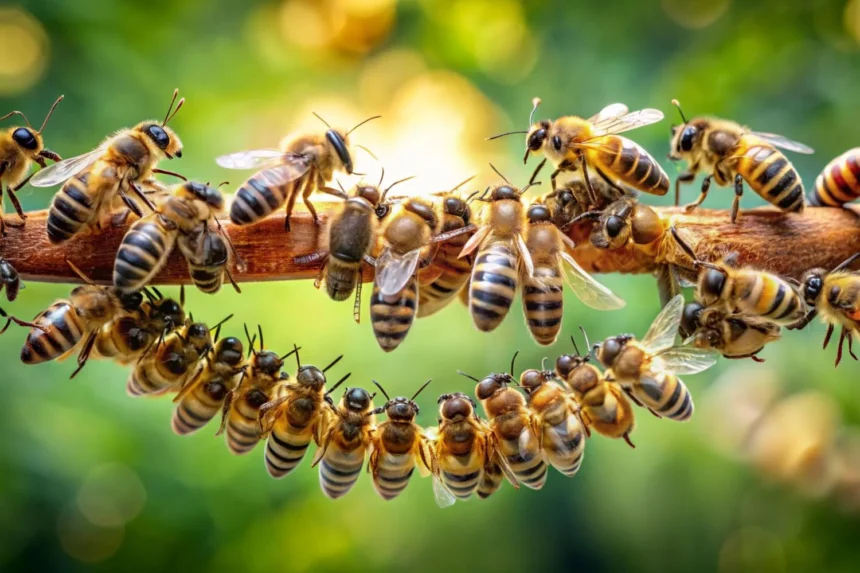
Peek inside a bee colony and you’ll see tens of thousands of individuals working in harmony. Some scout meadows for nectar, others tend to larvae, while the queen lays eggs and signals her presence chemically. Crucially, she doesn’t dictate who does what. The hive thrives without a central commander.
This decentralized system is echoed in ants and termites, while elephants, wolves, and baboons lean more toward hierarchy. But which system is more effective?
To find out, Zachary Kilpatrick, professor of applied mathematics, and colleagues Hyunjoong Kim (University of Cincinnati) and Krešimir Josić (University of Houston) built a mathematical model simulating bee colonies under different conditions, varying group sizes, environmental challenges, and leadership structures.
The results were striking:
Colonies with a central coordinator performed no better than those where individuals acted independently based on their own risk tolerance; In fact, leaderless groups often proved more resilient;
“We found that decentralized strategies of decision-making are at least as good as centrally coordinated ones and, in many ways, may be more robust and resilient,” said Kilpatrick.
Why? Because centralized systems are vulnerable. If the leader falters, communication collapses. In decentralized groups, multiple pathways keep the system alive.
Another key insight: the balance between bold explorers and cautious stay-at-homes; Small groups need a higher proportion of risk-takers to gather enough information; Large groups require fewer scouts, since each additional forager adds proportionally less new knowledge.
“If you send too many foragers out, you’re going to waste a bunch of energy for little additional benefit,” Kilpatrick explained.
This scaling logic, the researchers suggest, may apply to human organizations too, from startups to sprawling corporations.
Of course, its implications are way more than biology. These findings could shape the way artificial neural networks are designed and how multi-agent systems such as drone swarms coordinate, Kilpatrick notes.
“One of the best ways to design efficient systems and technologies is to look at what nature has done.”
But the study also offers a mirror for human societies. Our ancestral hunter-gatherer bands made decisions collectively. Modern organizations, however, often default to hierarchies as they grow. Yet history shows that breakthroughs, scientific discoveries, startups, and avant-garde art often emerge from risk-taking individuals who act without central direction, later drawing cautious followers into their orbit.
“Our research suggests that there can be a real benefit to having decentralized, individuated exploration that ultimately gets shared back with the community,” Kilpatrick said.
Whether in a buzzing hive or a bustling office, resilience may lie not in the hands of a single leader but in the collective wisdom of many. The bees remind us that communication, balance, and diversity of roles can make leaderless groups not just viable, but powerful.
Journal Reference:
- Hyunjoong Kim, Zachary Kilpatrick, and Kresimir Josic. Daring few, patient many: Division of labor in decentralized foraging collectives. PNAS. DOI: 10.1073/pnas.2605309123
Disclaimer: This content has not been generated, created or edited by Finance SC. Publisher:
Source link
Source link