



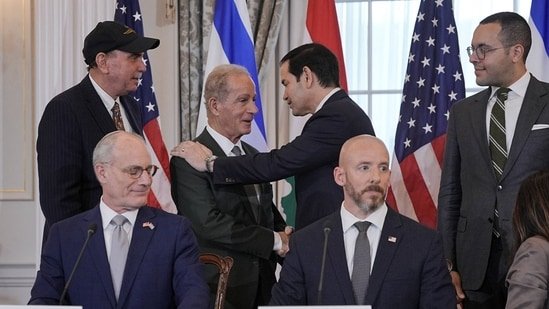
Israel, Lebanon and the United States signed a trilateral framework agreement on Friday following several days of talks aimed at ending the long-running conflict between Israel and Iran-backed Hezbollah militants.

Lebanese Ambassador Nada Moawad and her Israeli counterpart, Yechiel Leiter, signed the document alongside the US at the State Department in Washington, Reuters reported.
Ahead of the signing, US Secretary of State Marco Rubio described the agreement as an important first step. “Today we’ve taken the first step in what will be a difficult journey, without a doubt, but an important and an essential and a necessary one,” Rubio said.
“It’s the beginning of the beginning. There’s a lot of work ahead,” he added.
The agreement will be implemented through a trilateral Military Coordination Group for Lebanon, Rubio said in a statement. He added that Washington would commit significant resources to support the effort, including an immediate $100 million in humanitarian assistance in coordination with the United Nations, Reuters reported.
The statement also said the US reaffirmed its commitment to strengthening the Lebanese Armed Forces’ capabilities to “more effectively establish sovereignty throughout Lebanese territory,” with more than $30 million to be provided under existing US authorities and appropriations.
Israel’s ambassador to the United States, Yechiel Leiter, said the agreement marked a new chapter in relations between the two countries.
“Under the deal, Iran is out, Hezbollah is out, and the road to peace between Israel and Lebanon is in,” he said.
“Real peace, where both countries will live in security, where Israel’s and Lebanon’s sovereignty will be respected, honoured and protected,” Leiter added.
‘First step in restoring country’s sovereignty,’ says Lebanon
Lebanese President Joseph Aoun welcomed the agreement, describing it as the first step towards fully restoring the country’s sovereignty over its land and people.
“The framework agreement signed today is a first step” that will enable Lebanese “to return to their fully liberated lands, and to their certainly rebuilt homes… under the sovereignty of the Lebanese state that has no partner in its sovereignty over its land and people,” Aoun said, according to a statement released by his office, AFP reported.
“We swear to continue to work until this is fully achieved. There will be no more occupation, prisoners, subordination or tutelage,” he added.
Meanwhile, Lebanese Prime Minister Nawaf Salam said he looked forward to the “blessed” moment when Israeli troops begin withdrawing from southern Lebanon.
“I look forward to the blessed moment when Israel begins to withdraw — so that our dear people can return to their homes with safety and dignity — and to the launch” of reconstruction efforts, Salam said in a statement, according to AFP.
Hezbollah opposes agreement
Hezbollah has warned against the agreement, with the group’s lawmaker Hassan Fadlallah saying it could not be implemented without triggering a civil war.
“Lebanese authorities will be unable to impose the implementation of the agreement signed in Washington unless they go, with American support, to civil war,” Fadlallah said. His party has long opposed direct Israel-Lebanon talks, AFP reported.
He added that “what happened in Washington is an attempt to disrupt the Islamabad path, and without the resistance (Hezbollah) nothing will pass,” referring to the initial agreement between the US and Iran on halting the Middle East war, which includes Lebanon.
Netanyahu calls deal a ‘great achievement’
Israeli Prime Minister Benjamin Netanyahu hailed the agreement as a “great achievement” but said Israel would keep its troops in southern Lebanon until Hezbollah is disarmed and no longer poses a threat.
“The most important thing, first and foremost, is that Israel will remain in the security zone in southern Lebanon,” he said. “This is a major achievement, and we will maintain it as long as Hezbollah has not been disarmed and as long as it continues to pose a threat to the State of Israel.”
Netanyahu also said Israel was allowing the Lebanese army to begin preparing to take control of territory. “We are establishing two pilot zones, both based on the recommendation of the IDF,” he said. “The first is entirely outside the security zone and south of the Litani River. The second is north of the Litani.”
Netanyahu also said that civilians displaced from the so-called “security zone” in south Lebanon will not be allowed to return home under the new agreement, according to AFP.
Calling the agreement “a major blow to Iran”, Netanyahu said Tehran was trying to force Israel to withdraw from southern Lebanon.
“Iran is trying to force us into a withdrawal by force from southern Lebanon. And in effect, Israel, Lebanon, and the United States are telling them — this is none of your business.”
(With inputs from agencies)
Disclaimer: This content has not been generated, created or edited by Finance SC. Publisher:
Source link
Source link