



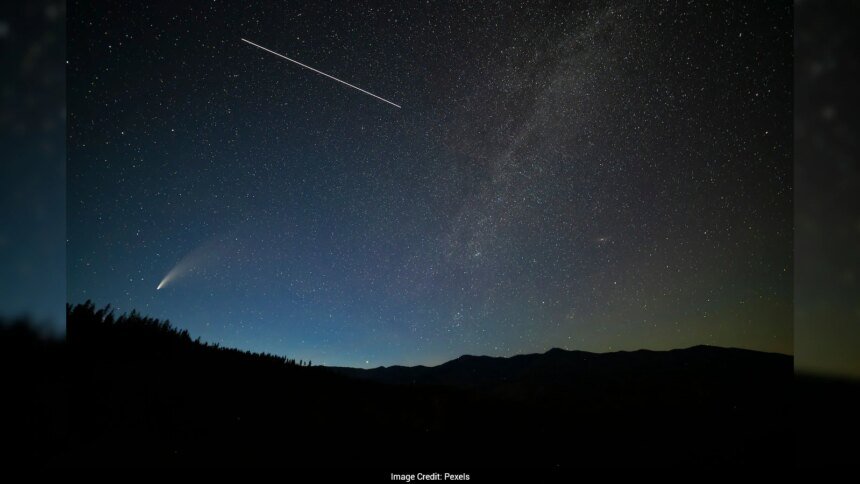
Scientists have discovered surprising details about a rare object that travelled into our solar system from another star system. By studying an interstellar comet, researchers gained new clues about the conditions that existed billions of years ago in a distant part of the galaxy, reported NASA.
As interstellar comet 3I/ATLAS began moving away from the Sun in December 2025, astronomers used NASA’s James Webb Space Telescope to capture detailed measurements of its chemical components. The comet had recently passed closest to the Sun, causing its ancient ice to turn into a bright cloud of gas, making it ideal for observation.
Webb collected detailed data, including chemical ratios of carbon and deuterium, also known as heavy hydrogen, that are not found in comets from the solar system. The findings surprised researchers, who used the comet’s composition to better understand the environment in which it formed.
A paper detailing the findings was published on June 22 in the journal Nature.
The comet gets its name from being the third confirmed interstellar comet, meaning it originated outside the solar system, and from the NASA-funded ATLAS (Asteroid Terrestrial-impact Last Alert System) telescope that first spotted it.
Martin Cordiner, an astro-chemist at NASA’s Goddard Space Flight Centre and lead author of the study, said the comet provided a unique opportunity to study an ancient object from a distant part of the galaxy that likely existed before the Sun and the solar system formed.
He said the research offers direct insight into that distant time and place while also helping scientists understand how unusual the solar system may be.
Cordiner and his team joined astronomers from various fields in studying 3I/ATLAS during its journey through the solar system. They received approval to interrupt Webb’s planned observations and use its Near-Infrared Spectrograph (NIRSpec) instrument to examine the comet.
NIRSpec revealed exceptionally high levels of deuterium, around 30 times higher than those seen in solar system comets. Researchers said this suggests that 3I/ATLAS may have formed in a very cold system much earlier in the history of the galaxy. During its formation, the material that became part of the comet was likely exposed to significant radiation but not enough long-term warmth to alter its heavy water ice into the type of water ice commonly found on Earth.
The instrument also detected only small amounts of carbon-13 compared to carbon-12. Scientists said this points to a very old origin because stellar systems gradually become richer in carbon-13 as generations of stars form and die. They noted that the solar system contains higher levels of carbon-13 because the Sun formed relatively recently, around 4.5 billion years ago.
The research team estimates that 3I/ATLAS may have formed between 10 and 12 billion years ago, during a period known as the universe’s “cosmic noon,” when star formation was at its peak. They believe the comet’s original system was located within a cold and dense cloud, and the large amount of heavy water suggests it spent its early years in a deeply frozen state.
Disclaimer: This content has not been generated, created or edited by Finance SC. Publisher:
Source link
Source link