


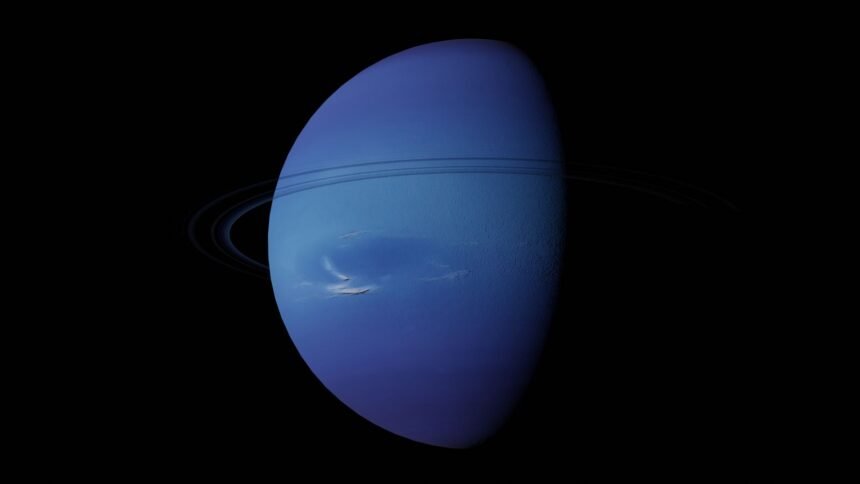
From a distance, the exoplanet HD 189733b looks like the most reassuring thing in the sky: a deep blue world, the same cobalt as Earth seen from orbit. The resemblance ends there, and it ends hard. The blue does not come from oceans. It comes from a scorching atmosphere hazed with silicate particles, the raw material of glass, in a place where that glass may fall sideways on winds of thousands of kilometres an hour.
It is, in other words, an Earth-coloured planet that is about as far from Earth-like as a planet can get.
A blue that was actually measured
The colour is not an artist’s guess. In 2013, astronomers using the Hubble Space Telescope measured it directly, by watching the planet’s light as it slipped behind its star and noting how the colour of the combined light changed. The dip told them what the planet alone was reflecting. The answer was a deep azure blue, and it was the first time the visible colour of a planet beyond our solar system had been pinned down.
HD 189733b sits about 63 light-years away and is what astronomers call a hot Jupiter: a gas giant the size of our own, but orbiting so close to its star that it laps it in roughly two days.
Why it is blue, and why that misleads
On Earth, blue is the work of water and air, sunlight scattering through the atmosphere and bouncing off oceans. It is tempting to read the same story onto any blue dot.
HD 189733b has neither ocean nor surface to speak of. It is a ball of gas, and its blue comes from high hazes laced with silicate grains that happen to scatter blue light while absorbing other colours. The outcome looks identical to Earth from far enough away. The cause could hardly be more different. Same colour, opposite reason.
Glass rain, sideways
The conditions that make those silicate hazes are brutal. The daytime atmosphere runs to more than 1,000 degrees Celsius, hot enough that silicates exist as vapour and then condense into tiny molten droplets of glass as they cool.
Add the wind.
Models of the planet put its atmospheric winds at around 7,000 kilometres an hour, something like seven times the speed of sound, which would drive those glass droplets horizontally rather than letting them fall in any gentle way. By one description, at that velocity a single droplet would strike with something like the energy of a small artillery shell. Hence the striking image that has stuck to this planet: rain made of glass, blowing sideways.
Two honest caveats belong with that picture. Because HD 189733b is a gas giant, there is no ground for rain to land on in the way it does on Earth; the droplets form and move within the atmosphere itself. And the sideways-glass description is an inference drawn from the silicate clouds and the modelled winds, not something anyone has photographed. It is a reasonable reading of harsh data, not a postcard.
What the colour really tells you
The useful lesson here is about how much a colour can hide. A blue planet is not a watery one by default, and the most Earth-looking dot in a telescope can turn out to be a furnace where the weather is made of glass.
HD 189733b is one of the most closely studied planets outside our system precisely because it is near enough and crosses its star often enough to interrogate. The more we learn about it, the clearer the warning becomes: at interstellar distances, appearances are a starting point for questions, not an answer to them.
Disclaimer: This content has not been generated, created or edited by Finance SC. Publisher:
Source link
Source link